
Advertisement
Advertisement
Iran and Oman have reached agreements on their respective share of the strategically important Strait of Hormuz and revenues generated from the waterway, Iran’s Islamic Revolutionary Guard Corps, IRGC, has said.
The development was disclosed by an IRGC spokesperson and reported on Wednesday by Iran’s semi-official Tasnim news agency, although details of the revenue-sharing arrangement and the precise scope of the agreement were not immediately made public.
The spokesperson also accused the United States of obstructing negotiations between Tehran and Muscat, saying the alleged interference had contributed to delays in reaching an agreement.
The announcement comes amid renewed diplomatic efforts by Iran and Oman to establish arrangements for navigation through the Strait, one of the world’s most strategically important maritime chokepoints.
The two countries have been negotiating a framework for managing navigation through the waterway, with Iranian Foreign Minister Abbas Araqchi saying earlier this month that Tehran and Muscat were close to reaching an agreement on a legal framework, including the designation of routes for vessels.
The negotiations have taken on greater significance after months of disruption to shipping through the Strait amid the wider confrontation involving Iran and the United States.
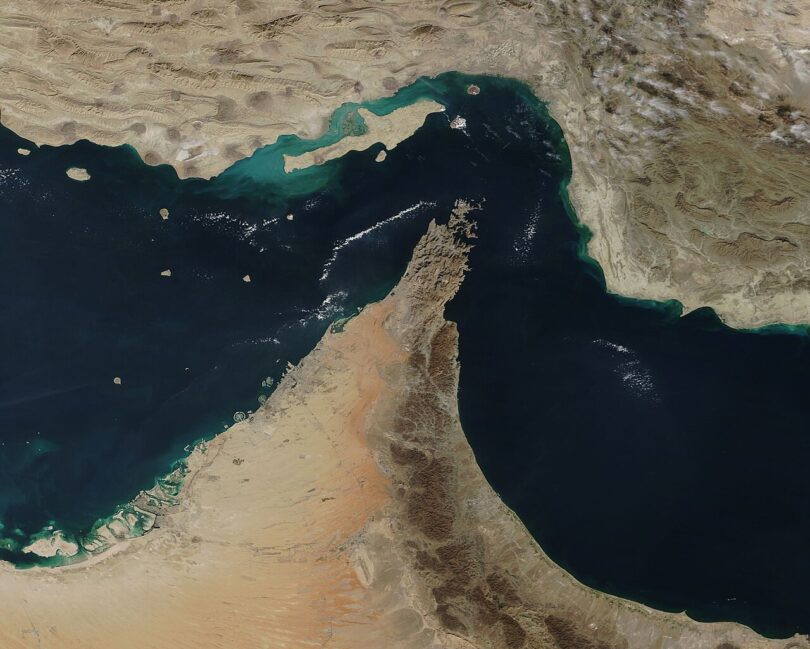
The Strait of Hormuz, located between Iran and Oman, connects the Persian Gulf with the Gulf of Oman and the wider Arabian Sea. It is a critical route for global energy supplies, with a substantial share of the world’s oil and liquefied natural gas shipments traditionally passing through the waterway.
Recent data showed that commercial traffic through the Strait remained significantly below normal levels. According to preliminary Kpler data reported by Reuters, only five commodity vessels transited the waterway on Tuesday, compared with a 10-day average of 15 vessels.
The latest Iran-Oman announcement follows discussions between the two countries over a temporary navigational corridor intended to facilitate the movement of commercial vessels while broader negotiations continue.
Iran and Oman have also been discussing mine clearance and a new traffic-management arrangement for the waterway. The proposed framework is expected to address the routes available to commercial vessels and mechanisms for coordinating maritime traffic.
Earlier in June, Tehran and Muscat agreed to continue negotiations on future navigation arrangements through a joint bilateral working group, while reaffirming their stated commitment to preserving the Strait of Hormuz as a secure and open international waterway.
However, Tehran has repeatedly made clear that an agreement between Iran and Oman alone would not necessarily result in the full reopening of the Strait.
Iranian officials have linked the reopening of the waterway to broader conditions involving the United States, including disputes surrounding an earlier memorandum of understanding.
Araqchi said on August 8 that while negotiations with Oman over management of the Strait were nearing completion, reopening the waterway remained dependent on the United States addressing what Tehran described as violations of the Islamabad memorandum.
The Strait’s status has therefore become a major point of contention in the wider diplomatic confrontation between Washington and Tehran, while Oman has continued to play a mediating role.
The latest announcement could nevertheless represent a significant step towards establishing a new framework for managing the waterway, particularly if the reported agreement on revenue-sharing is incorporated into a broader permanent arrangement.
The terms of the reported agreement, including what Iran and Oman mean by their respective “share” of the Strait and its revenues, were not disclosed in the initial report.
The announcement also comes as global energy markets closely monitor developments around the waterway. Renewed Iran-Oman talks had already contributed to a decline in oil prices, reflecting expectations that an arrangement could reduce the risk of prolonged disruption to energy shipments.
For international shipping and energy markets, the key question now is whether the reported Iran-Oman agreement can translate into sustained and predictable commercial navigation through the Strait.
Until the precise terms are published and broader disagreements involving Iran and the United States are resolved, significant uncertainty is likely to remain over the timing and extent of any full restoration of shipping through the vital waterway.