
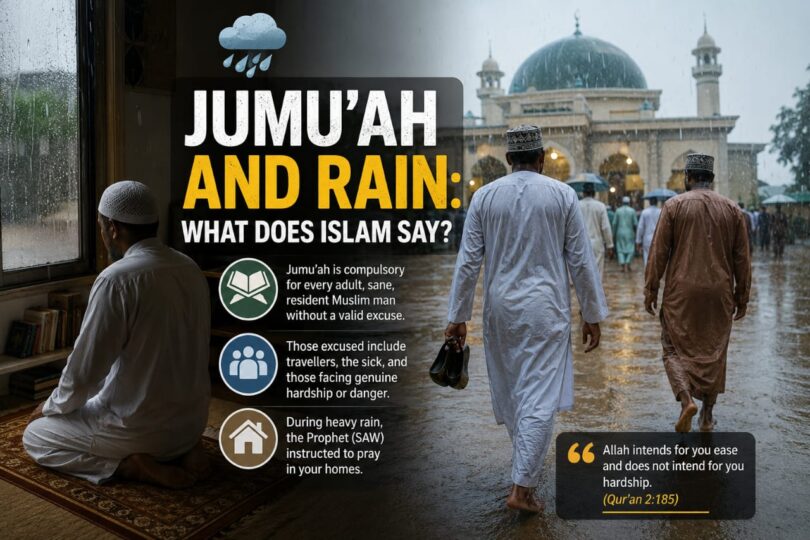
Jumu’ah (Friday prayer) is one of the most important acts of worship in Islam and is compulsory for every adult, sane, resident Muslim man who has no valid excuse.
The obligation is established in the Qur’an, where Allah says: “O you who have believed, when the call is proclaimed for prayer on Friday, hasten to the remembrance of Allah and leave off trade. That is better for you, if only you knew” (Qur’an 62:9).
However, Islamic law also recognises circumstances that may exempt a person from attending the congregational prayer.
Travellers, the sick, and those facing genuine hardship or danger are among those excused from Jumu’ah and may perform the regular Dhuhr prayer instead. The question of what constitutes a valid excuse often becomes a subject of discussion during the rainy season.
On Friday, as rain fell steadily across many communities in Kano State, Muslims responded differently to the weather.
Some made their way to mosques despite getting soaked on the journey. Others chose to remain at home and performed the Dhuhr prayer instead.
Read Also:Prominent Islamic Scholar, Sheikh Abdulqodir Al-Adaby dies in Kwara
In some circles, those who attended the mosque were praised for their commitment, while those who stayed back were quietly viewed as less devoted.
In this week’s SolaceBase newsletter, we examine what Islamic teachings actually say about attending Jumu’ah during heavy rainfall and whether choosing to pray at home under such conditions is a sign of weak faith or a concession recognised by the Qur’an and the Sunnah.
The importance of Jumu’ah is further emphasised in the Sunnah. The Prophet Muhammad (SAW) warned against repeatedly neglecting Friday prayers.
In a narration recorded in Sahih Muslim, he warned that those who persistently abandon Jumu’ah risk having their hearts sealed.
Another narration found in Sunan Abi Dawud and Jami’ at-Tirmidhi states that whoever misses three consecutive Friday prayers out of negligence will have a seal placed upon his heart.
Yet the same Sunnah that stresses the importance of Jumu’ah also provides guidance for difficult weather conditions.
Authentic narrations in Sahih al-Bukhari and Sahih Muslim report that the Prophet (SAW) instructed the mu’adhdhin to tell worshippers to pray in their homes when heavy rain created hardship.
Read Also:Zamfara lawmaker donates new vehicles worth N360m to 12 Islamic scholars
The Prophet’s instruction demonstrates that the concession is not based on convenience but on the principle of removing hardship from believers.
This principle is reflected in the Qur’an, where Allah says: “Allah intends for you ease and does not intend for you hardship” (Qur’an 2:185). In another verse, Allah says: “He has not placed upon you in the religion any hardship” (Qur’an 22:78).
Scholars explain that not every rainfall justifies missing Jumu’ah. Light rain that does not create significant difficulty ordinarily does not exempt a person from attending.
However, heavy rainfall, flooded roads, dangerous conditions, strong winds, or circumstances that expose worshippers to hardship or harm may be sufficient grounds for taking the concession.
This distinction is important because Islam does not measure faith solely by the amount of hardship a person endures. Rather, faith is demonstrated through obedience to Allah and adherence to the guidance of the Prophet (SAW).
Read Also:Katsina Govt. summons cleric for allegedly contravening Islamic law
As a result, a Muslim who attends Jumu’ah during heavy rain may be rewarded for his effort and sincerity. At the same time, a Muslim who remains at home because the weather presents genuine hardship may also be acting in accordance with the Sunnah.
The Prophet’s guidance therefore leaves little room for believers to judge one another in such situations. Those who attend the mosque should not assume superior piety, while those who take a legitimate concession should not feel that they have fallen short in their religious obligations.
The lesson from the Qur’an and Sunnah is clear: Jumu’ah remains a sacred obligation, but Islam also provides flexibility when genuine hardship arises.
During the rainy season, the question is not necessarily who walked through the rain and who stayed at home. Rather, it is whether each person acted sincerely and in accordance with the guidance that Islam provides.