By Aminu Abubakar
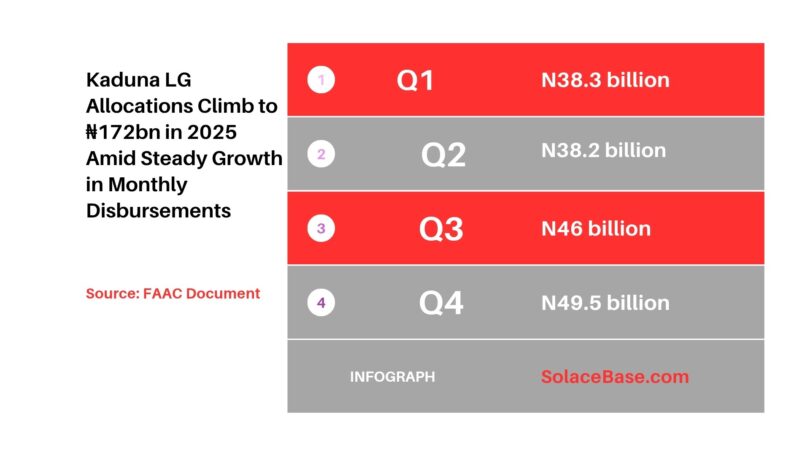
Local government allocations to Kaduna State recorded a steady rise in 2025, with total disbursements reaching about ₦172 billion over the 12-month period, reflecting a gradual increase in funding levels as the year progressed.
A SolaceBase review of the monthly figures indicates that allocations moved upward from ₦11.6 billion in January to a peak of ₦17.2 billion in October, before closing the year at ₦15.3 billion in December. The overall trend points to expanding inflows to local councils, with higher figures recorded in the latter part of the year compared to the earlier months.
In the first quarter, allocations remained relatively moderate. January posted ₦11.6 billion, the lowest monthly figure of the year, while February rose to ₦13.6 billion and March settled at ₦13.1 billion. The quarter’s cumulative total stood at approximately ₦38.3 billion, reflecting a stable but cautious start to the fiscal year.
The second quarter followed a similar trajectory, with only slight variations in monthly allocations. April recorded ₦12.2 billion, May increased to ₦12.9 billion, and June closed at ₦13.1 billion. Altogether, the quarter accounted for about ₦38.2 billion, nearly identical to the first quarter’s total, indicating continuity in funding levels during the first half of the year.
Read Also:Audit Report exposes massive financial irregularities in Kebbi local governments
From mid-year, allocations began to increase more noticeably. July saw a rise to ₦14.1 billion, followed by ₦15.6 billion in August and ₦16.3 billion in September. This brought the third quarter’s total to roughly ₦46 billion, marking a clear step-up from earlier periods and suggesting improved fiscal inflows or adjustments in revenue distribution.
The upward movement continued into the fourth quarter, which recorded the highest disbursements of the year. October led with ₦17.2 billion, the peak monthly allocation, while November followed closely at ₦17 billion. December recorded ₦15.3 billion, slightly lower than the preceding two months but still above most of the year’s earlier figures. The quarter’s cumulative total was approximately ₦49.5 billion.
Read Also:Jigawa Local Governments receive ₦158.8bn as federal allocations in 2025
Overall, the difference between the lowest monthly allocation in January and the highest in October stood at ₦5.6 billion, representing a significant increase over the course of the year. On average, local governments in Kaduna State received about ₦14.3 billion per month.
The gradual rise in allocations through the year may reflect broader fiscal developments, including variations in revenue shared through the Federation Account Allocation Committee (FAAC), which distributes income from oil and non-oil sources among the three tiers of government. Changes in global oil prices, exchange rate dynamics, and domestic revenue performance are among the factors that can influence these disbursements.
The increase in allocations from the middle of the year also coincides with periods when government spending typically gains momentum, particularly as budget implementation advances. Local governments often intensify project execution and service delivery efforts as more funds become available, especially in the latter half of the fiscal cycle.
Despite the overall growth recorded, the data underscores the importance of effective utilisation of public funds at the grassroots level. Allocations to local governments are critical for financing essential services such as primary healthcare, basic education, rural infrastructure, and sanitation. The extent to which these funds translate into tangible improvements depends largely on governance practices at the local level.
Read Also:Sokoto neglects Primary Healthcare, disburses just 5% of capital budget in 2025
Observers have consistently emphasised the need for transparency and accountability in the management of local government finances. While higher allocations can expand the capacity of councils to deliver services, the outcomes are ultimately shaped by how efficiently and responsibly the funds are deployed.
The figures also highlight the scale of public resources flowing to local governments within a single fiscal year. With total allocations reaching about ₦172 billion, Kaduna State’s councils had substantial financial inflows to support administrative functions and development initiatives across communities.
At the same time, the progression in monthly allocations provides insight into the fiscal environment in which local governments operated throughout the year. The relatively moderate figures in the early months, followed by sustained increases later on, suggest a dynamic revenue context influenced by both domestic and external economic factors.
The dip recorded in December, compared to the peak months of October and November, may be linked to routine fiscal adjustments or the winding down of financial activities toward the end of the year. Such variations are not uncommon and often reflect the closing phases of the budget cycle.
As attention turns to subsequent fiscal periods, the 2025 allocation data offers a useful benchmark for assessing trends in intergovernmental transfers and their implications for local governance. It also provides a basis for evaluating how effectively increased financial inflows are translated into development outcomes.
Ultimately, while the rising allocation figures point to expanding fiscal capacity, they also reinforce the need for sustained oversight and performance tracking. Ensuring that public funds are managed prudently remains central to achieving meaningful improvements in living standards at the community level.
The 2025 figures, therefore, present a picture of steady growth in local government funding in Kaduna State, alongside continuing expectations that such resources will be utilised in ways that deliver measurable benefits to residents across the state.
There have been concerns on how the Kaduna State Government utilises its funds.
It budgeted about N9 billion for foreign travel-related expenses in the 2026 fiscal year, a figure that is nearly seven times the N1.257 billion capital allocation to the Ministry of Internal Security and Home Affairs.
An analysis of the 2026 approved budget estimates shows that the foreign travel spending is clearly itemised under two major headings — International Travels (Estacodes) and International Travels (Others) — in addition to other trip-related allowances captured under personnel costs.
Breakdown of the N9bn foreign travel allocation shows that of the estimated N9 billion set aside for foreign trips: