Just a short walk from the centre of town is one of its most peaceful landmarks: the Ancient Theatre of Kas.
Built during the Hellenistic period and later expanded under the Romans, the theatre faces directly towards the sea. Today, it’s a quiet gathering place where locals and visitors sit together to watch the sunset over the Mediterranean.
It’s a reminder that the region’s history stretches back thousands of years, long before tourism ever arrived.
Travel, of course, isn’t only about landscapes or historical sites. Often, the most memorable moments come from meeting people with extraordinary stories.
In Kas, I meet Ufuk Kocak, a musician whose life reflects remarkable resilience.
After surviving the devastating 1999 Marmara earthquake, he lost both of his legs. But instead of allowing that moment to define him, he rebuilt his life in a completely new direction.
Ufuk is recognised as Türkiye’s first disabled scuba diving instructor — a role that inspires countless others who come to learn from him.
His story is a powerful reminder that strength often appears in the most unexpected forms.
Back along the coastline, adventure continues in another form: coasteering.
For those unfamiliar with the sport, it combines swimming, scrambling over rocks, cliff jumping, and navigating along rugged coastal terrain. The activity began in Wales in the 1980s and has slowly spread to other parts of the world.
In Türkiye, Kas is one of the few places where visitors can try it.
The experience is both physically demanding and incredibly rewarding. Moving along the rocky shoreline, jumping into clear water, and climbing back onto the cliffs offers a completely different way to experience the coastline.
Turkish hospitality
After a day like that, there’s only one proper way to recover: a traditional Turkish breakfast.
In Türkiye, breakfast isn’t rushed. It’s a social ritual — a table filled with small plates, local cheeses, olives, fresh bread, herbs, honey, jams, eggs, and vegetables.
At a countryside restaurant run by Guzin, the ingredients come directly from her own garden and farm. Tomatoes, cucumbers, peppers, fresh eggs, and even herbs are harvested on-site.
It’s a reminder of something simple but important: food tastes very different when you know exactly where it comes from.
And perhaps that’s part of what makes travel meaningful — reconnecting with traditions that slow life down and bring people together around the table.
From Kas, the road continues east along the Mediterranean to Demre, home to the ancient city of Myra.
More than two thousand years ago, this was one of the major cities of the Lycian civilisation. Today, visitors can still see the dramatic rock-cut tombs carved high into the cliffs, along with a remarkably well-preserved Roman theatre that once held thousands of spectators.
Standing in a place like this, it’s impossible not to imagine the lives that unfolded here centuries ago — the performances, the gatherings, the everyday moments of a civilisation long gone.
Nearby stands another site with a very different legacy: the Church of Saint Nicholas.
Saint Nicholas, a 4th-century bishop who lived in this region, became known for his generosity and acts of charity. Over time, his story travelled across cultures and centuries, eventually inspiring the global legend of Santa Claus.
It’s a reminder that even the most familiar traditions often begin in unexpected places.
Eventually, the journey returns to Kas, where the final moments are best spent quietly — away from crowds, with the sea stretching endlessly into the distance.
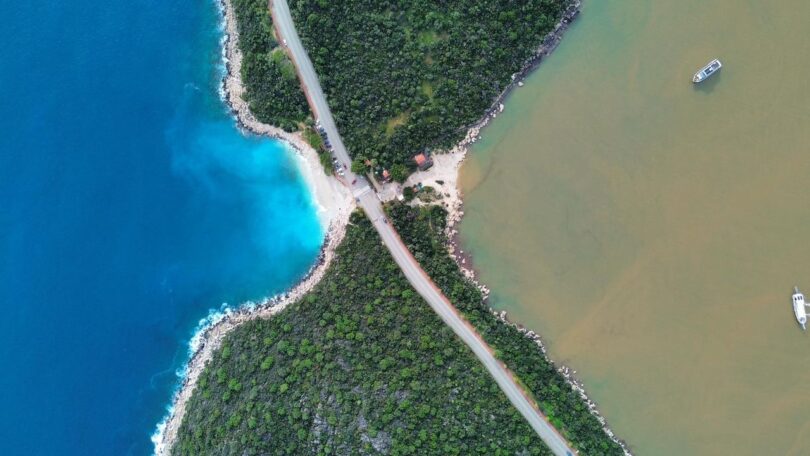
From the hills above the town, the view reveals why this place captures people’s hearts so easily.
Sometimes the best destinations are the ones you never expected to find.
And Kas, with its history, its people, and its calm Mediterranean spirit, is exactly that kind of place.