
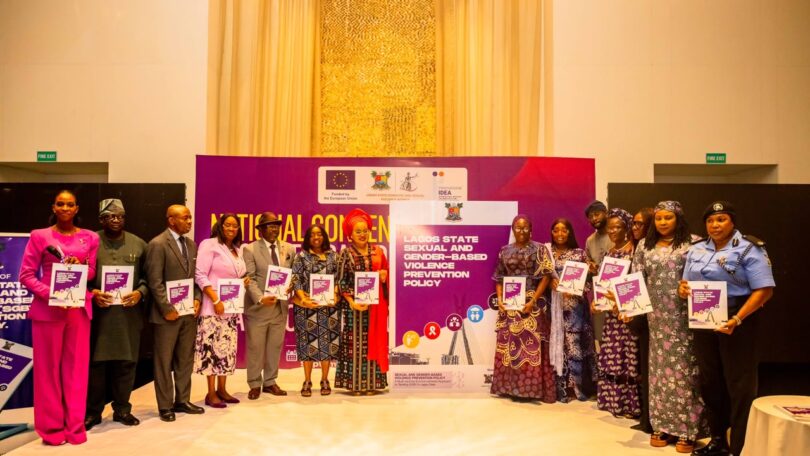
The Lagos State Government has launched its Gender-Based Violence (GBV) Prevention Policy as part of efforts to strengthen prevention, protection and coordinated responses to sexual and gender-based violence across the state…
The Lagos State Government has launched its Gender-Based Violence (GBV) Prevention Policy as part of efforts to strengthen prevention, protection and coordinated responses to sexual and gender-based violence across the state.
The policy, unveiled with support from the Ford Foundation, provides a framework for addressing GBV in homes, workplaces, educational institutions and digital spaces, including technology-facilitated sexual and gender-based violence.
It also marks a shift from a largely response-centred approach towards institutionalised prevention focused on tackling root causes, harmful social norms, protection and accountability.


Speaking at the launch, Executive Secretary of the Lagos State Domestic and Sexual Violence Agency (DSVA), Titilola Vivour-Adeniyi, said prevention must become a sustained and collective responsibility.
“We cannot continue to focus only on what happens after violence occurs. Prevention requires us to identify the factors that enable violence, challenge harmful social norms and strengthen the systems that protect people before harm occurs,” she said.
According to her, the policy provides a clear framework for coordinating prevention efforts across sectors and communities.
The policy is built around four pillars: primary prevention through education and awareness; secondary prevention through strengthened legal and policy frameworks; tertiary prevention through survivor-centred services; and quaternary prevention through capacity building for first responders.
Implementation will be overseen by a multi-sectoral Technical Working Group anchored by the DSVA, in collaboration with relevant ministries, departments and agencies, as well as civil society organisations.
The launch coincided with the National Convening of GBV State Coordinators, which brought together stakeholders from across Nigeria to strengthen a unified and coordinated response to gender-based violence.
The two-day convening, held from September 24 to 25, 2026, was themed, “Strengthening a Unified and Coordinated Response to Gender-Based Violence in Nigeria.”
The forum provided an opportunity for stakeholders to review existing GBV structures, identify gaps and challenges, and improve collaboration on prevention and response mechanisms nationwide.
The programme was organised with support from the Rule of Law and Anti-Corruption Programme (RoLAC) and the End Sexual and Gender-Based Violence Programme (ESGBV), funded by the European Union and implemented by the International Institute for Democracy and Electoral Assistance (International IDEA).
Welcoming participants, Lagos State Attorney-General and Commissioner for Justice, Lawal Pedro, SAN, stressed the need for stronger coordination among states and institutions in tackling GBV.
He said the new Lagos policy would further strengthen the state’s prevention framework and provide a structured approach to addressing the root causes of gender-based violence.
Goodwill messages were delivered by the Chief Judge of Lagos State, Justice Kazeem Alogba; Speaker of the Lagos State House of Assembly, Mudashiru Obasa; Attorney-General of the Federation and Minister of Justice, Lateef Fagbemi, SAN; and Minister of Women Affairs and Social Development, Imaan Sulaiman-Ibrahim.
The European Union Delegation to Nigeria and ECOWAS was also represented.
Senior Programme Manager at International IDEA, Dr Oluwatoyin Badejobin, said the convening would enable states to learn from one another, identify areas requiring improvement and develop practical commitments towards stronger GBV prevention and response systems.
The First Lady of Lagos State, Dr Ibijoke Sanwo-Olu, also addressed the gathering, highlighting the need for sustained commitment and collective action to prevent GBV and protect women, children and other vulnerable persons.
The policy was formally launched by the Governor of Lagos State, Babajide Sanwo-Olu, who was represented by the Secretary to the State Government, Abimbola Salu-Hundeyin.
Sanwo-Olu described the national convening as a strategic platform for strengthening institutional capacity, fostering inter-state collaboration and harmonising mechanisms for responding to GBV.
He urged participating states to share experiences, strengthen referral pathways and build systems that place survivors at the centre of interventions, while advancing prevention efforts at community and institutional levels.