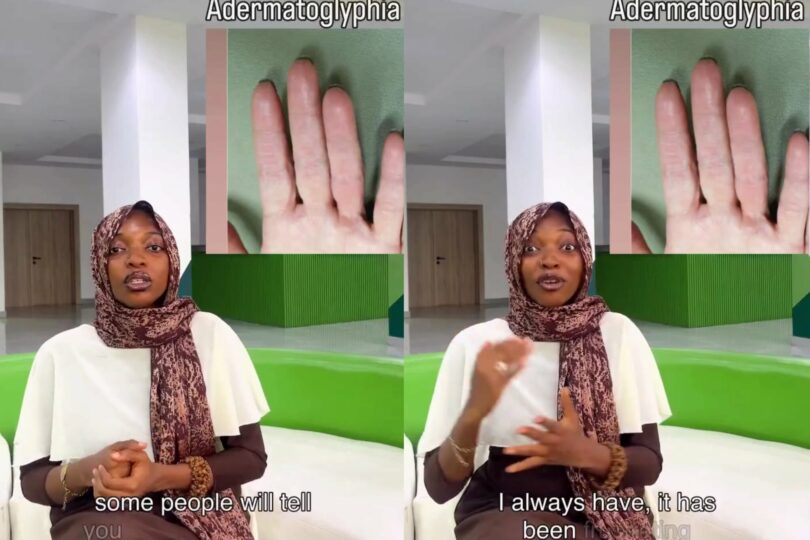
A Nigerian lady born without fingerprints has opened up about the unusual challenges she has faced with identification and biometric registration in Nigeria, revealing how she once cried after watching more than 200 people register for JAMB ahead of her.
The woman, who identified her condition as adermatoglyphia, said she initially believed she was the only person in Nigeria experiencing the condition until she made a joke about it on Instagram and nearly 100 people contacted her to share similar experiences.
According to her, the condition has affected several aspects of her life, particularly situations requiring fingerprint verification.
She has had to repeatedly explain her situation at institutions including JAMB, NYSC and banks.
Lady recalls difficult JAMB registration experience
The woman said her first JAMB registration was particularly distressing as she watched over 200 people complete their registration before her because she could not provide a readable fingerprint.
She said, “When I wanted to write my first JAMB, I watched over 200 people register before me. I cried.”
She recalled being advised to try substances and materials including sand, chalk, GB, spirit and watermelon in an attempt to make her fingerprints readable. At one point, she said she even scrubbed her hands against a stone before eventually managing to register.
Fingerprint challenges continue
The lady further explained that her difficulties have persisted beyond JAMB, noting that there were occasions when she could successfully thumbprint into a system but could not thumbprint out.
She said, “Living without thumb print in Nigeria is terrible.”
According to her, she has sometimes had to use her feet to complete fingerprint verification because of her condition.
Her experience has also sparked wider discussion after several people reportedly contacted her to disclose that they face similar fingerprint-related challenges, suggesting that her struggle may be shared by others navigating Nigeria’s increasingly biometric-dependent systems.
Watch the video below…
A Nigerian lady born without fingerprints recounts her JAMB and NYSC biometric struggles pic.twitter.com/H5cFFhxtON
— Nigeria Stories (@NigeriaStories) August 24, 2026