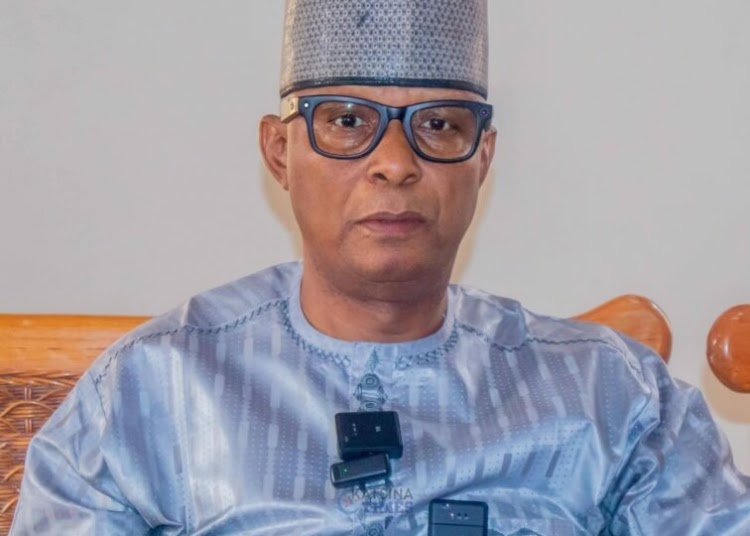
Muttaqha Rabe Darma has been named as the ministerial nominee and minister-designate for the Housing and Urban Development Ministry.
This is according to a memo signed by the Secretary to the Government of the Federation, Senator George Akume, on Tuesday, which stated that President Bola Tinubu approved a minor cabinet reshuffle in the Federal Executive Council. Darma is to replace Arc. Ahmed Musa Dangiwa as Minister of Housing and Urban Development.
The memo directed Dangiwa to hand over to the Minister of State in the ministry, with all transition processes expected to be completed by Thursday, April 23, 2026.
Dr. Muttaqha Rabe Darma brings experience from both the public and private sectors, with a background spanning governance, energy, and investment management.
He previously served as Chief Executive Officer of the Petroleum Technology Development Fund (PTDF) between 2008 and 2012 and earlier worked as Commissioner in the Katsina State Government from 2003 to 2007.
He also had private sector experience at Coshcaris Group Limited.
Since 2012, he has served as President of Pleasant Investment, with interests in oil, gas, and energy-related operations.
Academically, he holds a Doctor of Business Administration from the University of Liverpool, a PhD in Industrial Engineering from Atlantic International University, and additional qualifications in Mechanical Engineering and Business Administration from Bayero University, Kano.
His appointment as Housing minister-designate is subject to Senate confirmation.
The Ministry of Housing and Urban Development is implementing key initiatives under the Renewed Hope Estates and Cities programme, aimed at delivering 100,000 housing units nationwide.
The scheme operates through two models: the Estates programme, funded via government budgetary allocations with subsidised infrastructure and state-provided land, and the Cities programme, executed under public-private partnerships where developers finance construction and infrastructure, resulting in higher costs.
However, implementation updates have remained limited for more than a year after its announcement, while millions of land assets remain outside the formal economy due to a lack of documentation, restricting access to credit and investment.
If effectively executed, the reforms could significantly reshape Nigeria’s housing and land administration system.