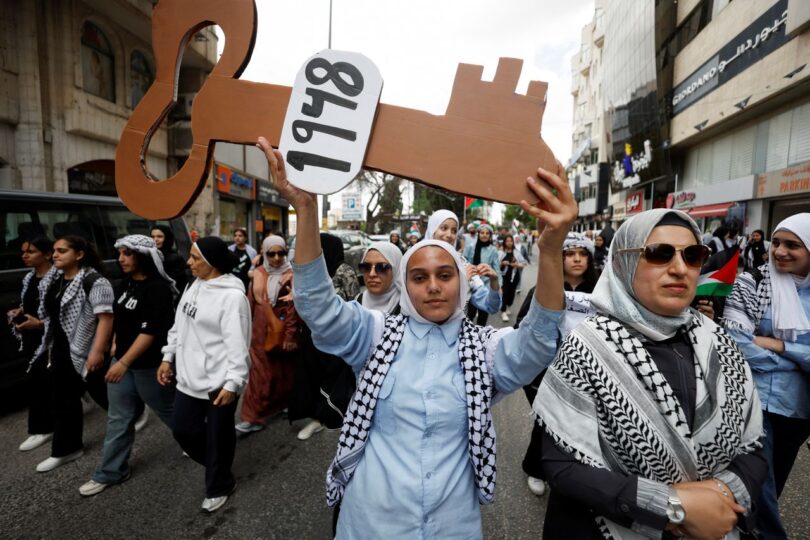
It is 1948, and the setting is Ein Karem, Jerusalem, in historic Palestine.
Leila Giries, eight, and her family are caught off guard when Zionist Jewish militias, such as the Hagana and Lehi, start rampaging through their village, massacring many of its residents and expelling survivors of the carnage.
Fleeing the village, Giries’ family takes only their house key and a few personal belongings, in the hope that they would return soon.
Fast forward to 2026.
The location is California, the western US state. And Giries is 86 now. She still remembers being forced from her land by what later became the occupying Israeli military.
She has strong memories of the separation from her family and friends during what is known as Nakba, Arabic for “catastrophe” — the 1948 violent expulsion, dispossession, and ethnic cleansing of some 750,000 Palestinians by the Zionist militias during the creation of Israel.
“Of course, everybody fled. All our family and friends. They fled because of the shelling,” Giries, the Nakba survivor, tells TRT World.
Giries recounts how her family and thousands of other Palestinians fled, expecting a swift return. “That was the last time we set foot there,” she notes, adding the families couldn’t take all of their belongings.
“My mom had a small bag… and she put a few belongings for me in that bag. And I still have the bag. I framed it because that’s what we came out with.”
Giries says she tries to avoid recalling the Nakba, describing it as a period of profound hardship. “I was only eight years old, but I remember so much, and especially how we were separated from family and friends.”
‘The longing for homeland never leaves us’
Every year, May 15 marks the anniversary of the Nakba. For many Palestinians, a future of peace depends on Israel acknowledging this past. Since 1948, Palestinians have annually commemorated the day to reaffirm their right to return to their homes and villages in historic Palestine.
Arabs in general and Palestinians in specific often mark May 15 as a reminder of their collective suffering, their ancestral home, the continued occupation of the West Bank and the blockaded Gaza by Israel.
Palestinians legally hold the “right of return” to their own lands, which are now considered Israeli territory, according to the UN General Assembly Resolution 194 of 1948.
Millions of Nakba survivors are living with their descendants in refugee camps in blockaded Gaza, occupied West Bank and other neighbouring countries. Others such as Giries ended up across the Atlantic in the US.
Giries says her family first headed to Jordan after their exile, then to Iraq, where they lived for 10 years.
“We left for Jordan, and in Jordan, my uncle, who was a doctor in an American hospital in Iraq in Baghdad, sent a taxi looking for us, and they found us in As-Salt, a town called As-Salt,” she says, referring to an old highway leading from Jordan’s capital, Amman, to Jerusalem.
“So we went to Amman, and a taxi was waiting for us. My father, my mother and my grandmother, my paternal grandmother, the taxi took us to Baghdad. Took two nights on the road, and we stayed there for 10 years.”
Her father, John, migrated from Iraq to the US after being sponsored by his brother, a doctor and US citizen.
Her father later opened his business in the US and sponsored the rest of the family in 1958.
Despite building a successful life in the US, Giries says her longing for Palestine remains undiminished.
“I’ve been here since 1958, but the longing for the homeland never leaves us. My grandmother died here in the United States. They couldn’t be buried next to their husbands in Palestine, and that was a very sad time for them, for all of us,” she says.
In 1984, she returned to Ein Karem for a visit. Her family’s house, however, wasn’t there anymore.
“In 1984, my father took me to Palestine, and the first stop was Ainkarim. I remembered so much of this little town where our house stood; it was overgrown with trees,” she recounts.
“My house was bombed in 1949, never knew the reason why.”
Left temporarily, never returned
Yousef Kassim, a 40-year-old lawyer who lives in the US state of Texas, tells TRT World that in 1948, his then two-year-old father, Yousef Y. Kassim, fled their village of Lifta after Zionist forces launched attacks.
“During the Nakba, Zionist forces came to a coffee shop in Lifta, killed seven people, and terrorised the entire village. There was also fear that women would be attacked. As a result, my father and his family fled,” says Kassim.
Lifta is a traditional Palestinian village on the outskirts of Jerusalem in historic Palestine, and Zionist militias displaced all its residents during the Nakba in 1948. Lifta lies slightly over 1 kilometre away from Deir Yassin, where Zionist militias committed the infamous massacre against Palestinians on April 9, 1948.