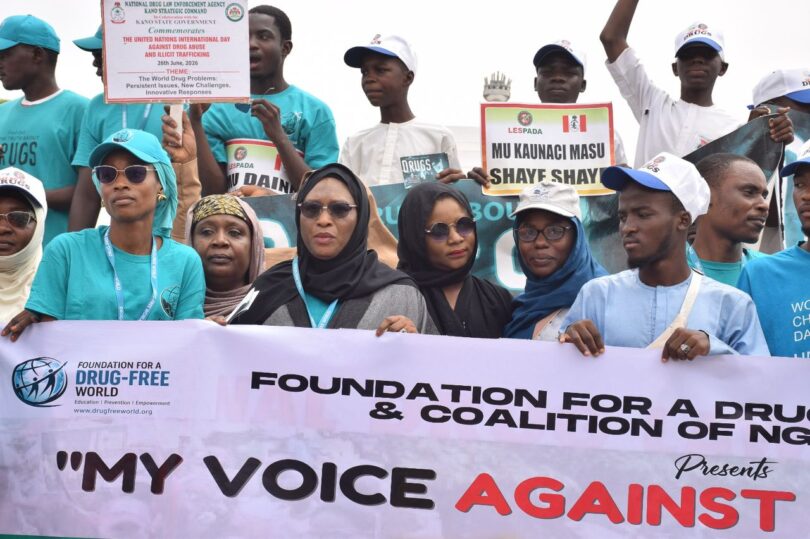
The Nigeria Association of Women Journalists (NAWOJ), Kano State chapter, on Saturday joined the Coalition of NGOs Against Drug Abuse (CONADA) and other civil society organisations in a road walk to commemorate the 2026 International Day Against Drug Abuse and Illicit Trafficking, as part of efforts to raise awareness about the dangers of substance abuse.
The development was disclosed in a statement signed by the Chairperson of NAWOJ Kano State, Sayyida Bahijja Malam Kabara, and made available to journalists in Kano.
The road walk, which commenced from Maiduguri Road and terminated at the Kano State Government House, attracted journalists, anti-drug advocates, civil society groups and other stakeholders committed to combating substance abuse.
SolaceBase reports that other organisations that participated in the exercise included LESPADA, NACCRAN, YOSPIS, Widi-Jalo Foundation, YAADAI, IYECF, TAFTA, Jam’iyyar Matan Arewa and the Visionary Women for Empowerment and Humanitarian Foundation (VWEHF), among others.
Kabara described the growing rate of substance abuse among young people as alarming and called for urgent and coordinated efforts by all stakeholders to address the challenge.


“The rate of substance abuse, particularly among young people, has reached alarming levels and requires urgent and coordinated action from all stakeholders,” she said.
Read Also:‘Drug Trafficking’: Court adjourns pilgrim’s suit against Ethiopian Airlines, SAHCO over wrongful arrest in Saudi Arabia
She commended Kano State Governor Abba Kabir Yusuf for approving the constitution of a Special Task Force on Drug Abuse and Illicit Trafficking, noting that the move demonstrated the administration’s commitment to tackling substance abuse and drug-related crimes in the state.
According to her, the establishment of the task force reflects a renewed determination by the state government to confront the growing menace of drug abuse through collaborative and strategic interventions.
Kabara also congratulated Ambassador Maryam Hassan of LESPADA and Hajiya Maryam Ardi Muhammad on their appointments to the task force, saying their selection was a recognition of the contributions of civil society organisations to the fight against drug abuse.
“We commend Governor Abba Kabir Yusuf for constituting the Special Task Force on Drug Abuse and Illicit Trafficking. We also congratulate Ambassador Maryam Hassan of LESPADA and Hajiya Maryam Ardi Muhammad on their well-deserved appointments to the committee,” she stated.
She noted that their appointments underscored the important role civil society groups continue to play in promoting safer and healthier communities.
Read Also:EDITORIAL: Kano’s Missing Millions: Why young entrepreneurs are still struggling for capital
The NAWOJ chairperson urged parents, government agencies, religious leaders, schools and community-based organisations to work collectively towards preventing drug abuse and supporting the rehabilitation of affected persons.
“We must not leave this responsibility to the government alone. Every segment of society has a role to play in protecting our youths from the dangers of illicit drugs,” she added.
Kabara further stressed the need for sustained public enlightenment campaigns and youth empowerment programmes, arguing that such initiatives would significantly reduce the prevalence of substance abuse across the country.
Read Also:EDITORIAL: Kano’s Missing Millions: Why young entrepreneurs are still struggling for capital
The International Day Against Drug Abuse and Illicit Trafficking is observed annually on June 26 to strengthen international action and cooperation towards achieving a society free from drug abuse.
In Nigeria, drug abuse remains a major public health concern. According to official statistics, more than 14.3 million Nigerians between the ages of 15 and 64 use drugs, highlighting the need for intensified prevention, treatment and intervention programmes.