Nigerian Newspapers reported on a wide variety of topics ranging from the race by State to cut Transport costs through the use of CNG powered buses to the move for an improvement of the minimum wage of Nigerian workers and the issues in the polity as the 2027 elections gradually……
Nigerian Newspapers reported on a wide variety of topics ranging from the race by State to cut Transport costs through the use of CNG powered buses to the move for an improvement of the minimum wage of Nigerian workers and the issues in the polity as the 2027 elections gradually draws nearer.
1. The Punch leads with a report on the race by States across the country to reduce transport costs in line with the announced schedule by the Federal government and the States to cut transportation costs by the 1st of October.
As the Federal Government moves to deliver measurable reductions in transportation costs from October 1, states are adopting different approaches to the Compressed Natural Gas initiative, with some already operating subsidised transport services while commercial operators in several others complain about inadequate refuelling infrastructure, high conversion costs and long queues at existing stations.
The uneven rollout has raised questions about the ability of transport operators and state governments to deliver cheaper fares across the country within the timeline set by President Bola Tinubu.
The President, after meeting the 36 state governors on August 27, announced an implementation committee for the National Affordable CNG Transit Programme under the Nigeria Governors’ Forum, chaired by Governor AbdulRahman AbdulRazaq.
In an update on Saturday, Tinubu urged states to work with transport unions and commercial operators, support vehicle conversion and fleet deployment, and ensure that savings from cheaper energy were passed on to commuters through lower fares.
The Presidency said more than 120,000 vehicles had been converted, with over 400 certified conversion centres and more than 90 CNG refuelling stations across the country. Read More in The Punch Newspapers
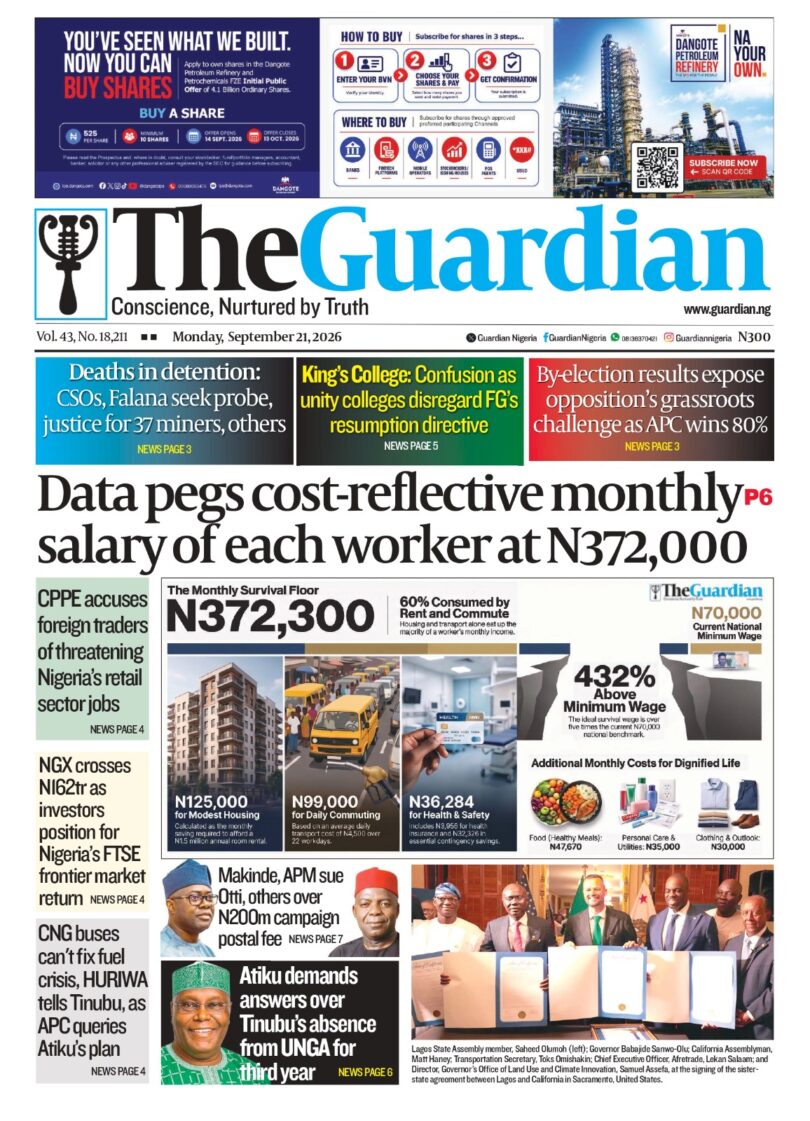
2. The Guardian leads with a report on what it says the data is saying about a cost reflective minimum wage for workers across Nigeria.
A single worker in any of Nigeria’s urban centres would need to earn a minimum of N372,300 monthly to reasonably survive what has become the new normal across cities, data analysed by The Guardian revealed.
The amount falls below what could be regarded as a living wage as it is stripped of social life spending, skills development budget, guest entertainment, family support and other frivolities but includes a modest savings to reasonably cover immediate costs in case of job loss. It is N302,300 above the current N70,000 national minimum wage.
The revelation comes a few months into 2027, when the current minimum wage would be ready for review. Already, labour leaders are demanding as much as N1,000,000, forcing employers, who are reeling from the high cost of energy and other production rigidities, to call for a fair new wage floor setting.
The cost of living has increased geometrically in the past three years, following the removal of the fuel subsidy, which increased the price of premium motor spirit (PMS) by 600 per cent, and naira depreciation, a direct result of the foreign exchange (FX) market liberalisation.
The Guardian’s ideal wage model captures key personal expenditure lines, including accommodation, food, daily commuting, health, personal care, clothing and a modest contingency savings. The model assumes that the individual in life is self-reliant and does not have to support any other members of his family, a simplified assumption that does not reflect the real situation. Read More in The Guardian Newspapers
3. This Day in one of its lead stories reported on the National Social Investment Programme’s Conditional Cash Transfer Scheme to vulnerable Nigerians disclosing that 67.2 Million Nigerians are covered under the scheme.
The World Bank has reported that Nigeria’s cash-based social intervention programmes reached 67.19 million people and 10.44 million households by August 2026, even as questions over the identification and traceability of beneficiaries continue to trail the federal government’s cash transfer programme. DownloadInteractive Maps
In its latest Implementation Status and Results Report on the National Social Safety Net Programme-Scale Up, World Bank said 10.43 million poor and vulnerable households had received economic shock-responsive cash transfers.
The report said more than 7.1 million households had received all three tranches of the transfer after undergoing biometric verification using their National Identification Numbers (NINs) or Bank Verification Numbers (BVNs).
But the scale of the figures comes against continuing concerns over the ability to independently verify the beneficiaries and payments. Many Nigerians, including the opposition parties, have raised issues over the transparency of the programme.
For instance, Auditor General for the Federation’s office, in its 2024 annual report on non-compliance/internal control weaknesses, had questioned the documentation supporting N33.751 billion in electronic transfers to 3,295,207 households and beneficiaries across 35 states in 2023. Read More in This Day
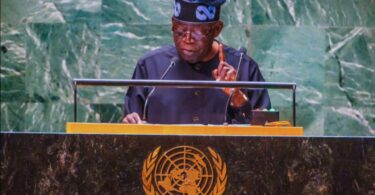
4. The Nation in one of its front page lead Stories report on the participation of Nigeria in the United Nations General Assembly and the statement by Nigeria’s permanent representative to the UN, Jimoh Ibrahim, on how prominent Nigeria will be presenting its views to the world community despite the absence of President Tinubu at the summit.
More than 60 per cent of those listed to speak at the ongoing 81st session of the United Nations General Assembly (UNGA) are being represented by either their vice presidents or foreign ministers, Nigeria’s Permanent Representative to the UN, Ambassador Jimoh Ibrahim, has said. NigeriaNews Subscription
The envoy also assured that Nigeria would retain its designated position at the UNGA, including its front-row seat, as Vice President Kashim Shettima stands in for President Bola Ahmed Tinubu.
Ibrahim, who chairs the UN Committee on Budget and Administration, said the Minister of Foreign Affairs, Ambassador Bianca Odumegwu-Ojukwu, and other top government officials would also join the Vice President at the high-level session.
In a statement by the Nigerian Mission to the United Nations in New York, Ibrahim noted that it is not unusual for countries to delegate representation to senior government officials when their presidents are unable to attend. JoinDiaspora Networks
“The Vice President and the Minister of Foreign Affairs are adequately positioned to represent Nigeria at the General Assembly and participate fully in the diplomatic engagements surrounding the session,” he said. The envoy explained that President Tinubu would not personally attend the session as he is currently in France on annual leave.

5. The Nigerian Tribune in one of its lead stories reports on the continuing efforts to enhance security across Nigeria especially the Northwest with the training by the Nigerian Army to Forest Guards in Borno State.
The Nigerian Army has trained 925 forest guards from Borno in a two-week theatre acclimatisation programme at the North-East Theatre Training School, BuniYadi, Yobe.
The News Agency of Nigeria (NAN) reports that the training was designed to equip the forest guards with basic military skills and enable them to provide auxiliary support to troops fighting terrorism and insurgency.
The Theatre Commander, Operation Hadin Kai, Maj.-Gen. Ibikunle Ajose, who made this known on Sunday at the graduation ceremony, however, said the training was not intended to turn the forest guards into full soldiers.
Ajose, represented at the passing-out ceremony, said the training was designed to bring the guards above paramilitary standards while preparing them to operate alongside military personnel.
According to him, the trainees underwent training in weapon stripping and assembly, aiming and firing, ambush tactics, cordon and search operations.
“They were also trained in Improvised Explosive Device (IED) awareness, handling of suspected terrorists, drug-abuse prevention, unarmed combat and self-defence.
“The trainees also learnt how to operate under difficult terrain and adverse weather conditions,” he said.