
…pushes CNG, EV conversion, charging stations nationwide
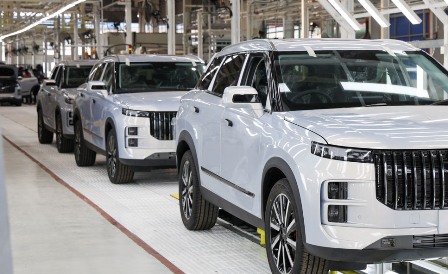
The National Automotive Design and Development Council, NADDC, has disclosed that Nigeria now has 40 vehicle assembly plants in operation nationwide, with Innoson Motors ranking as the largest.
NADDC’s Director of Media and Communications, Mrs Susan Taiwo, stated this during a one-day training session for the Commerce and Industry Correspondents’ Association of Nigeria, CICAN, on Thursday in Abuja.
Taiwo told participants that the growth marked a dramatic turnaround from the state of the industry when she first began working in the sector over 20 years ago.
“When we started, those of us who were there know that there was no assembly plant in Nigeria that was working.
“But by the special grace of God, we have almost 40 assembly plants now that are functioning, at least 40 that are assembling cars here in Nigeria,” she said.
She cited Mikano, a company more widely known for generators, as one example of a firm that has since moved into vehicle assembly, noting that she personally drives a Chang’an model assembled by the company.
Taiwo said Nigeria’s automotive industry is now pivoting toward cleaner transport alternatives, including compressed natural gas, CNG, and electric vehicles, EVs, describing it as part of a broader “clean air revolution.”
She said the Council had begun licensing conversion centres across the country to support the shift to CNG.
“We are creating centres for conversion, for CNG, worldwide and nationwide,” she said, adding that training sessions were underway this week in every geopolitical zone to teach technicians how to convert and install CNG systems in vehicles, with hundreds of people being trained in each zone.
On electric vehicles, she said NADDC had piloted charging stations at select high-end outlets, but stressed that scaling up the initiative would require significant private investment.
“There is no way you can travel with an electric vehicle now in Nigeria if investors don’t come in and start putting charging stations all over,” she said, pointing to the United States, where drivers can typically find a charging or refuelling station roughly every two hours on the road.
Taiwo said the Council views itself as a catalyst rather than the sole driver of the industry’s transformation.
“The automotive industry is not a government industry. It is for individual investors to come in and take up from where we stop and invest, especially in the new trend of CNG and electric vehicles,” she said.
She added that the Council would continue to support private investment in charging infrastructure and conversion capacity as demand for cleaner vehicles grows. “We cannot be left behind. We have to dance to the trend,” she said.
Taiwo used the session to appeal for closer engagement between the Council and industry correspondents, saying NADDC’s work often goes unrecognised because it is not adequately publicised.
“If you don’t amplify what you are doing, nobody will know what you are doing,” she said, while describing the training as the start of a more regular briefing arrangement with journalists covering the sector.