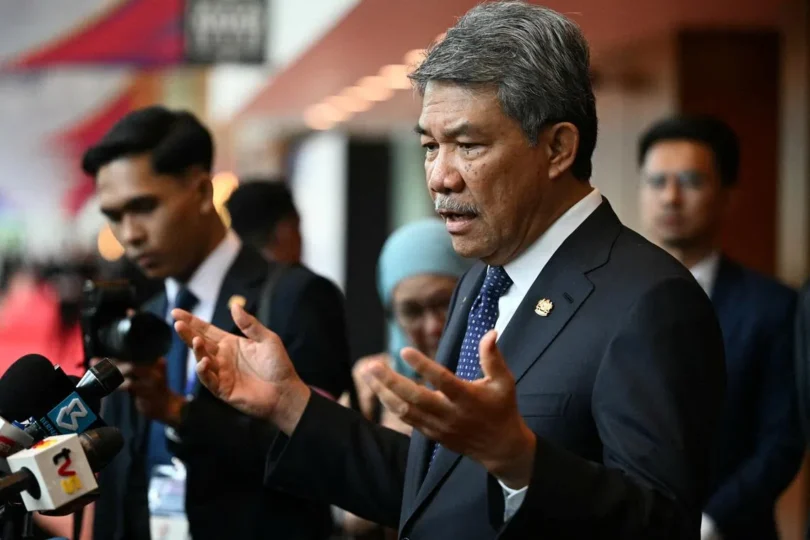
KUALA LUMPUR — Malaysia’s Foreign Minister Mohamad Hasan said no country can unilaterally determine access to the Strait of Malacca, in response to remarks by Indonesia’s finance minister that a toll could be charged on ships using the waterway.
Datuk Seri Mohamad said Malaysia, Singapore, Indonesia and Thailand shared a “watertight understanding” on the status of the 900km strait.
“Whatever is to be done in the Strait of Malacca must involve the cooperation of all four countries. That is our understanding – it cannot be done unilaterally,” he said on April 22 at a forum in Kuala Lumpur on the impact of the US-Iran conflict on Malaysia.
“When we entered into a joint agreement on patrols and the security of the Strait of Malacca, that was the basis – there are no unilateral decisions.”
He was responding on the same day that Indonesian finance minister Purbaya Yudhi Sadewa suggested that countries along the strait could impose a levy on ships passing through the strait – similar to Iran’s plans to charge vessels transiting the Strait of Hormuz.
More than 200 vessels — including container ships, oil tankers and bulk carriers — transit the Strait of Malacca daily, amounting to over 90,000 ships a year, or about a quarter of global traded goods. This is roughly double the number of ships passing through the Strait of Hormuz.
The Strait of Malacca is far narrower than Hormuz, tapering to just 2.7km at its tightest point near Singapore, with an average depth of about 25m.
“We are on a strategic global trade and energy route, but we do not charge ships passing through the Strait of Malacca,” Dr Purbaya had said at a financial symposium in Jakarta. “Now Iran is looking to charge ships passing through the Strait of Hormuz.”
He added that any move to do the same in the Strait of Malacca would have to involve Malaysia and Singapore, the other littoral states along the Malacca Strait.
“If we split it three ways between Indonesia, Malaysia and Singapore, that could be quite something, right?” said the minister with a laugh.
Dr Purbaya said the idea was in line with Indonesian President Prabowo Subianto’s directive for Indonesia to play a bigger role in global trade, prompting the country to “start thinking more offensively” about its resources.
But the Indonesian minister tempered his remark and said such a proposal is not simple.
“Singapore is small, Malaysia is similar (to Indonesia) – perhaps we could split it in two. If only it were that simple, but it isn’t,” Dr Purbaya said.
Separately on April 22, Singapore’s Foreign Minister Vivian Balakrishnan said Indonesia, Malaysia and Singapore shared a strategic interest in keeping the straits of Malacca and Singapore open, noting that all three are trade-dependent economies and work together to maintain free passage through the waterways.
“The right of transit passage is guaranteed for everyone,” Dr Balakrishnan said at a CNBC event in Singapore. “We will not participate in any attempts to close or interdict or to impose tolls in our neighbourhood.”
He had earlier defended Singapore’s decision not to negotiate such tolls with Tehran, instead affirming the freedom of navigation guaranteed under the United Nations Convention on the Law of the Sea (UNCLOS).
The international treaty ensures that all ships – including warships – can navigate seas and straits without undue interference.
Speaking in Parliament on April 7, Dr Balakrishnan said the right of transit passage is not a privilege granted by bordering states. “It’s not a licence to be subjugated at all. It is not a toll to be paid. It is a right of all nations’ ships to traverse,” he said.
Spillover anxiety from the disruption in the Strait of Hormuz has reached South-east Asia, partly driven by a step-up in defence cooperation between Jakarta and Washington, which signed a Major Defence Cooperation Partnership on April 13.
While the pact makes no mention of the strait and is framed as an effort to modernise Indonesia’s defence capabilities, a greater American presence in the region risks heightening tensions with China, which has long viewed the Strait of Malacca as critical to its energy security.
This so-called “Malacca dilemma” was raised in 2003 by then Chinese president Hu Jintao, who said: “Certain major powers have all along encroached on and tried to control navigation through the Strait of Malacca.”
Around 80 per cent of China’s oil imports pass through the strait, and any disruption would pose a strategic chokehold on its economy.
In Malaysia, heightened interest by major powers in the region has prompted the opposition bloc Perikatan Nasional (PN) to urge Prime Minister Anwar Ibrahim’s government to keep a close watch on developments and ensure that the country is not drawn into conflict.
In a statement on April 18, PN secretary-general Takiyuddin Hassan said Malaysia must continue to promote dialogue, de-escalation and the peaceful resolution of disputes.
“As one of the world’s most vital maritime trade routes, any attempt to increase external strategic presence or exert influence over the Strait of Malacca risks escalating geopolitical competition and destabilising the region,” he said.
“At a time of increasing global uncertainty, maintaining an independent and principled foreign policy is essential to protect Malaysia’s long-term interests and regional stability.”
Sign up for our weekly Asian Insider Malaysia Edition newsletter to make sense of the big stories in Malaysia.