By Yushau A. Shuaib
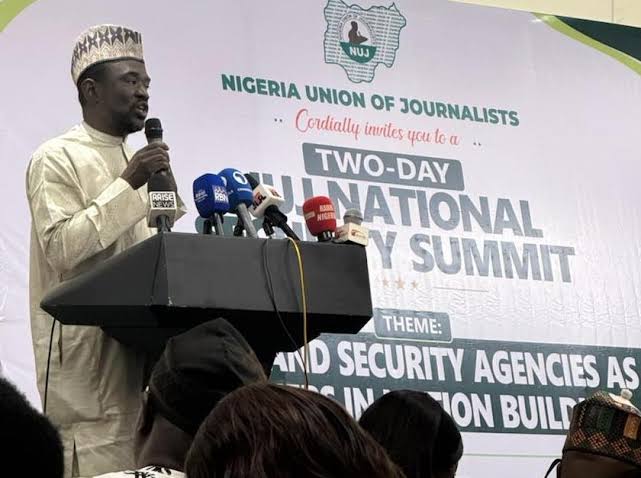
Crisis communication teaches one hard truth: silence doesn’t calm a crisis — it fuels it. When leaders fail to engage, their silence is easily read as indifference. That was the uncomfortable impression some participants felt during the second day of the recent National Security Summit organised by the Nigeria Union of Journalists (NUJ) in Abuja, where senior security officials were absent.
Were security chiefs concerned that journalists might demand answers about the persistent allegations linking illegal mining activities in bandit-prone areas to the financing of criminal networks? Could they have been uncomfortable addressing claims that some retired and serving security personnel have been implicated, directly or indirectly, in the worsening insecurity across the country?
Could they also have feared being asked whether the nation’s democratic authorities and security leadership possess the political will and operational latitude required to confront these monumental challenges, especially amid claims that some major financiers and sponsors are known yet remain untouchable?
And what about the resurgence of mass abductions and kidnappings — particularly in schools — spreading beyond their traditional epicentres, raising concerns about whether these attacks are being orchestrated for political motives or illicit financial gain?
While there may be no evidence to support such suspicions, insecurity thrives in the shadows where transparency is absent. The summit, themed “Media and Security Agencies as Partners in Nation Building,” was conceived as a platform to foster understanding between two institutions whose responsibilities frequently intersect—the media and the security services.
Read Also:Unregulated foreign access to Nigeria’s media space fuelling insecurity — NUJ
The opening day was impressive. It drew a diverse audience of journalists, academics, communication specialists, development partners, security personnel, and government officials. The Minister of Information and National Orientation, Malam Mohammed Idris Malagi, was the most senior figure in attendance, adding weight to the proceedings. Discussions focused on strategic communication, responsible journalism, national security, and the importance of collaboration in addressing Nigeria’s complex security challenges.
However, the second day—which was designed as the technical session devoted specifically to national security issues—presented a different picture.
The security chiefs whose institutions were central to the conversation were conspicuously absent. More disappointing was the fact that many of them were neither physically present nor represented.
Ironically, the discussions that day could have benefited enormously from their participation. The keynote speaker, Mr. Musikilu Mojeed, President of the International Press Institute (IPI) Nigeria, delivered a well-researched paper on the delicate relationship between the media and security institutions. He examined several historical and contemporary cases that highlighted tensions, misunderstandings, and occasional confrontations between journalists and security agencies.
During his presentation, he referenced the controversial 2014 incident in which security operatives intercepted newspaper distribution vehicles—an episode that drew widespread criticism from media organisations and civil society groups.
What Mr Mojeed perhaps did not know was that one of the principal actors in that period, former Director of Defence Information, Major General Chris Olukolade (rtd.), was quietly seated at the back of the hall with a former Director of Naval Information, Commodore Kabir Aliyu (rtd.). I was privileged to sit beside them as the presentation progressed.
Read Also:EDITORIAL: Why kidnapping remains Nigeria’s most immediate security challenge
General Olukolade, currently the Chairman of the Centre for Crisis Communication (CCC) is not known for reopening old controversies. In fact, he has consistently avoided public discussions about many military operations and sensitive decisions from previous eras. Yet, on this occasion, he felt compelled to provide clarification.
When given the microphone, he explained that at the time, during the administration of Goodluck Jonathan, security agencies were grappling with evolving terrorist tactics, including intelligence reports suggesting that insurgents were exploring unconventional methods of transporting weapons and logistics across the country.
More importantly, he revealed something that many critics may not have known: the security command later acknowledged public concerns over the incident and apologised.
According to him, lessons were learned, and safeguards were introduced to ensure that such actions would not recur. He added that ‘dialogue often achieves what assumptions cannot.’
To my surprise, I was also invited to the podium to contribute to the discussion on media-security relations. My intervention was modest. Rather than focusing on disagreements, I chose to highlight examples of productive collaboration between journalists and security agencies through the Forum of Spokespersons of Security and Response Agencies (FOSSRA), an initiative once chaired by General Olukolade and later by the late Major General Abubakar Rabe.
I remembered the professionalism of editors who placed national interest above sensational headlines. One notable example involved a senior editor of ThisDay Newspaper, Ms Ijeoma Nwogwugwu, who received a late-night request in June 2013 from military authorities regarding a specific word used in a report on insurgency operations.
Read Also:Editorial: Abubakar Rabe’s death and Nigeria’s lingering insecurity crisis
The concern was that publishing certain details could jeopardise an ongoing mission. After reviewing the implications, the newspaper agreed and made the adjustment. The operation was subsequently adjudged successful.
I also recalled my May 2014 visit to Premium Times’ headquarters after a report on an alleged mutiny by soldiers in Borno State. At the time, I passionately appealed to the newspaper’s leadership to consider replacing the word “mutiny” with “protest” because of the severe legal implications of mutiny under military law.
While the then Managing Editor, Musikilu Mojeed, listened attentively and showed understanding, the story had already gained traction elsewhere. Eventually, some of the affected soldiers were convicted of mutiny.
Similarly, I recounted how Mallam Hamza Idris, then Daily Trust Bureau Chief in Borno in February 2015, filed what appeared to be a routine report.