
Oil contributed just 4.04 per cent to Nigeria’s GDP in the first half of 2026, down sharply from 8.87 per cent in 2017, according to data released by BudgIT Nigeria….
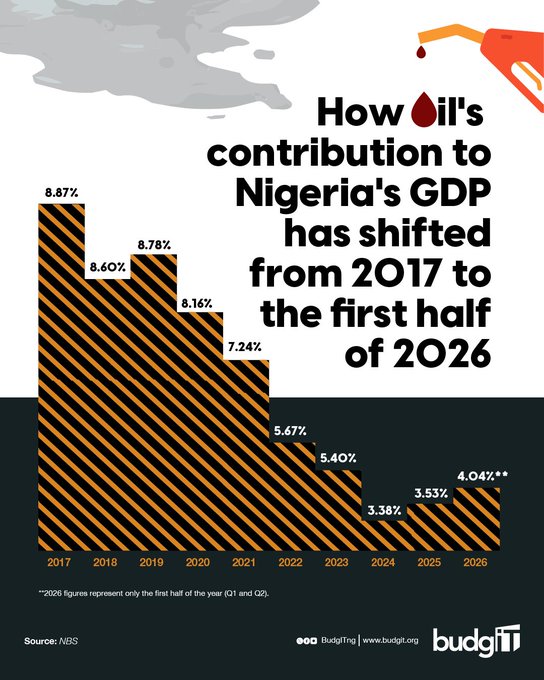
Oil contributed just 4.04 per cent to Nigeria’s GDP in the first half of 2026, down sharply from 8.87 per cent in 2017, according to data released by BudgIT Nigeria.
The civic organisation said the figures suggest that Nigeria’s economy is gradually becoming less dependent on oil for overall economic output, even though petroleum remains critical to government finances.
BudgIT said oil’s contribution to GDP stood at 8.87 per cent in 2017, 8.16 per cent in 2020, 7.24 per cent in 2021, 5.67 per cent in 2022, 5.40 per cent in 2023 and 3.38 per cent in 2024, before rising to 4.04 per cent in the first half of 2026.
It noted that the 2020 figure came amid the COVID-19 pandemic and the global collapse in oil prices, while production challenges from 2021, including oil theft, production shortfalls and crude output below Nigeria’s OPEC quotas, further weakened the sector.
According to BudgIT, the first-half 2026 figure represents the first meaningful recovery in oil’s GDP contribution since 2019, although it cautioned that two quarters were insufficient to determine whether the improvement would be sustained.
The organisation said a declining oil share of GDP could indicate that non-oil sectors are growing faster and the economy is becoming more diversified.
However, it highlighted a major contradiction in Nigeria’s economic structure: oil may account for a relatively small share of economic output, but it continues to dominate government revenue.
BudgIT’s Beyond Extraction report found that oil and gas account for nearly 60 per cent of Nigeria’s total government revenue on average.
This, it said, means that while Nigeria may be reducing its economic dependence on oil in terms of GDP, the government remains substantially exposed to fluctuations in petroleum earnings.
The data therefore points to a widening gap between the structure of Nigeria’s economy and the structure of its public finances — with the non-oil economy becoming increasingly important to GDP while oil continues to have an outsized influence on what government can spend.