
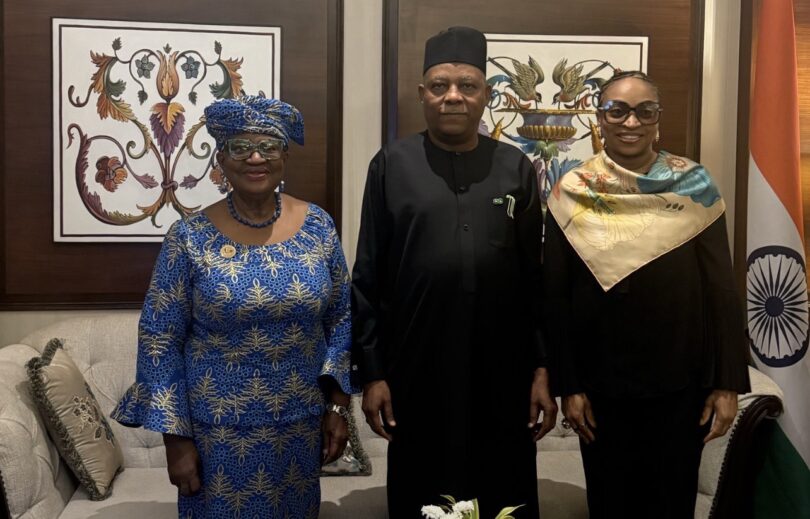
World Trade Organisation (WTO) Director-General, Ngozi Okonjo-Iweala, has met with Vice President Kashim Shettima on the sidelines of the 18th BRICS Leaders’ Summit in New Delhi, India, with both sides discussing global trade issues and their implications for Nigeria and Africa. Okonjo-Iweala disclosed the meeting in a post on X,……
World Trade Organisation (WTO) Director-General, Ngozi Okonjo-Iweala, has met with Vice President Kashim Shettima on the sidelines of the 18th BRICS Leaders’ Summit in New Delhi, India, with both sides discussing global trade issues and their implications for Nigeria and Africa.
Okonjo-Iweala disclosed the meeting in a post on X, thanking Shettima and the Nigerian delegation, which included the Minister of Industry, Trade and Investment, Dr Jumoke Oduwole, for what she described as a “very good meeting.”
“Many thanks to H.E. Vice President Kashim Shettima of Nigeria and his delegation, including Honourable Minister of Industry, Trade and Investment Dr. Jumoke Oduwole, for a very good meeting on the sidelines of BRICS in Delhi, where we discussed global trade issues and their impact on Nigeria and Africa. Mr. Vice President reconfirmed Nigeria’s commitment to the Multilateral Trading System at its core,” she wrote.
Shettima is representing President Bola Tinubu at the BRICS summit, which is taking place in New Delhi from September 12 to 13, 2026.
Nigeria became a BRICS partner country in January 2025, joining a group that has expanded its engagement with emerging economies and developing countries. The partnership provides Nigeria with another platform to deepen economic, trade and investment relations with major economies while advancing its interests in the Global South.
The meeting between Shettima and Okonjo-Iweala comes amid growing international discussions over the future of global trade and the role of the WTO in maintaining a rules-based international trading system.
Read Also: Shettima Arrives India To Represent Tinubu At BRICS Summit
The BRICS summit has placed significant attention on global economic governance, trade and efforts to reform international institutions. Discussions around unilateral tariffs, trade restrictions and the need to strengthen the multilateral trading system have featured prominently in the wider conversations.
In his engagement with Okonjo-Iweala, Shettima reaffirmed Nigeria’s support for the WTO and multilateralism, stressing the importance of international cooperation in addressing global economic challenges.
“I believe the world is greater than one nation. We will continue to support the WTO in championing the cause of multilateralism. We are essentially one human family and interconnected. You cannot divorce yourself from the global community,” the Vice President said.

Shettima also highlighted the economic contributions of migration, arguing that countries and cities can benefit from the skills, ideas and investments brought by people who move across borders.
“Nations are built by immigrants. Even cities are built by people who came from outside, not just by the locals. That goes to show that we have so much to gain from global migration,” he said.
The Vice President cited the Nigerian diaspora as an example of how citizens living outside the country contribute to development through their professional expertise, businesses and other activities.
Shettima also commended Okonjo-Iweala for her leadership of the WTO.
“You are doing a very wonderful job at the WTO, but you still have a lot to contribute to humanity,” he told the WTO Director-General.
Nigeria’s participation in BRICS reflects the Federal Government’s broader effort to expand economic partnerships beyond traditional markets and strengthen its position within emerging global economic groupings.
The country’s status as a BRICS partner also gives it an avenue to engage with major emerging economies on issues including trade, investment, industrial development, technology and sustainable development.
The meeting also underscored Nigeria’s position that its growing engagement with BRICS and other emerging-economy platforms can complement, rather than replace, its participation in the wider multilateral trading system.