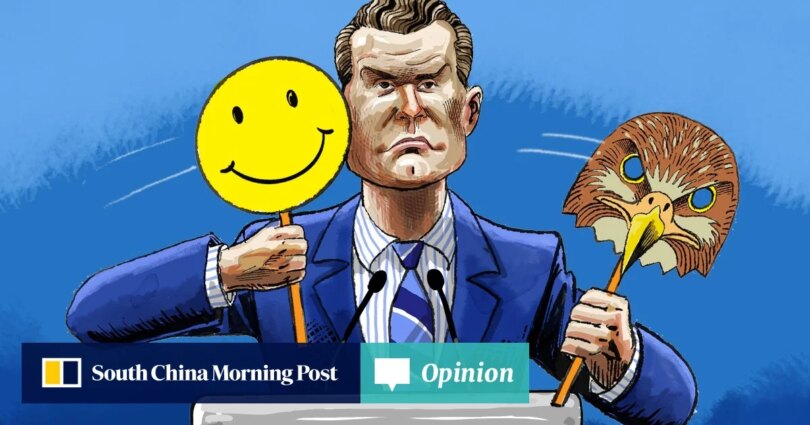
Listening to US Defence Secretary Pete Hegseth at the recently concluded Shangri-La Dialogue in Singapore, I thought of the iconic Sichuan opera act of face-changing, where performers switch masks in an instant.
Last year, Hegseth’s speech at the event was filled with blatant attacks on China. This year, he put on a completely different face, declaring that: “Under President Trump’s leadership, relations between the United States and China are better than they’ve been in many years.”
Why this 180-degree turn? The answer lies in Donald Trump’s recent visit to Beijing, hailed by him as a “tremendous success”. If unwavering loyalty is the foremost requirement from Trump, then Hegseth’s performance, as one of his top lieutenants, perfectly embodied this ethos.
Hegseth’s speech did not mention Taiwan. Again, this was no surprise. Trump, it seemed, had little to say on the Taiwan issue in Beijing. On his way back, he said he had not yet decided on US arms sales to Taiwan, that “we’re supposed to travel 9,500 miles (about 15,300km) to fight a war. I’m not looking for that”.
Washington will find it increasingly hard to sell arms to Taiwan. As the China-US power gap narrows, Beijing now has a spectrum of retaliatory tools: cancelling pre-agreed bulk purchases from US firms, imposing sanctions on American defence contractors, or staging larger, more frequent and complex military exercises around the island.
Beijing can even deploy all three tactics simultaneously in a coordinated counterstrike to maximise pain on the US. Washington will ultimately be forced to assess if these arms sales, while lucrative, draw the US into an unwinnable military conflict.