
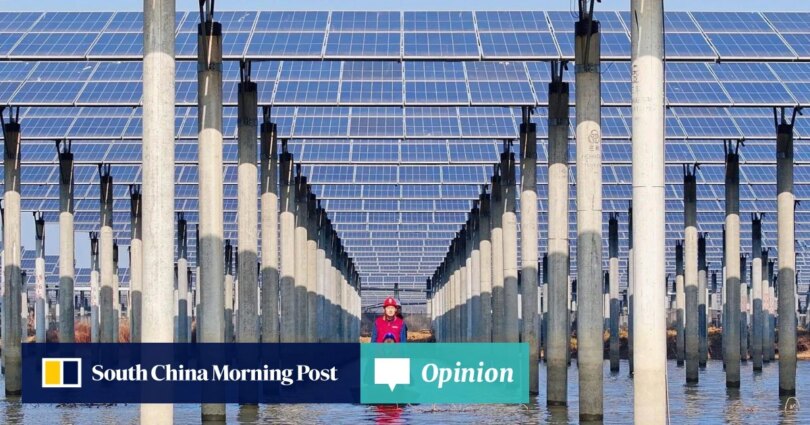
There is something odd about the debate on China’s “overcapacity”. Europe says the world needs cheaper and faster clean energy deployment, yet complains when China produces the solar panels, wind turbines, batteries and electric vehicles that make this possible.
Bruegel, a Brussels-based think tank specialising in economic policy, recently published a working paper, “To what extent can green infrastructure investment mitigate China’s clean-energy overcapacity?” It argues that China’s industrial policies made it the global leader in renewable technologies but at the cost of severe overcapacity, falling prices and weaker profitability.
China has enormous production capacity, but it has also deployed renewable energy at extraordinary speed at home, and exports have grown because prices are attractive. The question is not simply whether China produces too much. It is why the same scale can be seen as a threat by some economies, a climate opportunity by others, and both at once by some.
A recent South China Morning Post opinion piece made a related point: China may be the visible pressure, but not necessarily Europe’s real problem. Europe’s deeper difficulty lies in competitiveness, investment, energy costs, technology gaps and the inability to turn defensive measures into industrial renewal.
That observation applies beyond Europe. China’s clean tech expansion has been extraordinary. Its companies have brought down costs across solar, wind, batteries and electric vehicles. Cheap solar panels are not a climate problem; they are part of the climate solution. Many developing countries would find decarbonisation much harder at Western production costs.
Yet China’s success creates discomfort. Other economies see manufacturers squeezed, worry strategic industries will disappear, and fear dependence on one country for future technologies. These concerns are understandable. But they are not proof that China has violated any settled international principle.