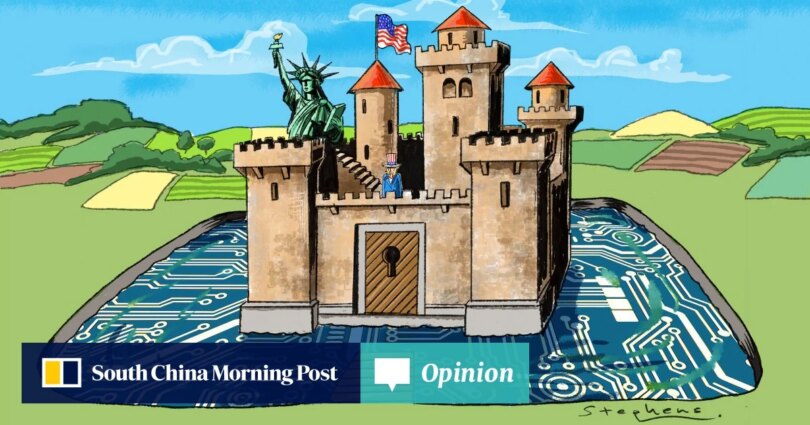
The United States House Select Committee on China recently released a report on artificial intelligence. Titled “Buy What It Can, Steal What It Must: China’s Campaign to Acquire Frontier AI Capabilities”, it captures a hardening view in Washington that Beijing’s artificial intelligence rise is closely tied to both market access and security concerns.
Whether fully substantiated or not, such beliefs are increasingly shaping the policy lens through which technology competition between the two countries is understood in the US – less as a matter of innovation, and more as one of national security.
Against this backdrop, recent controversy over model distillation involving leading US firms – including OpenAI, Anthropic and Alphabet – has drawn a great deal of attention. The coordination among these companies, coming soon after Washington’s push to build a “full-stack AI export” system, suggests that what appears to be a technical dispute is in fact part of a broader shift in how AI is governed – and contested – globally.
At first glance, the debate over model distillation concerns technical pathways and intellectual property boundaries. Distillation is a widely used machine learning technique that enables smaller models to approximate the performance of larger ones, reducing computational costs and accelerating adoption. Its legal status remains ambiguous, and even US firms have used similar methods among themselves.
However, in today’s geopolitical environment, the issue has been reframed. Some US policymakers and companies argue that distilled models could be misused for cyber operations, disinformation campaigns or even military applications. What was once a question of optimisation has been elevated to one of national security.
This shift reflects a deeper transformation in AI governance in the US. Over the past few years, Washington has moved from a primary focus on AI safety – including ethical risks and algorithmic harms – towards a more security-driven paradigm centred on strategic competition and technological control. Rhetoric around safety has not disappeared, but it is increasingly fused with national security considerations.
🚨BREAKING: Watch the full clip here ➤