
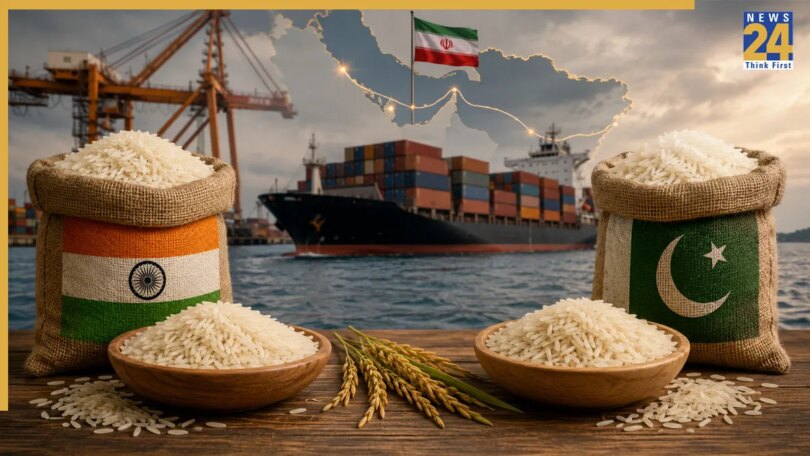
The competition between India and Pakistan in the global basmati rice market has entered a new phase following the reopening of shipping routes through the Strait of Hormuz. Both countries are major exporters of basmati rice and depend heavily on demand from Middle Eastern markets such as the UAE, Saudi Arabia, Iran, Iraq, Kuwait, Qatar, and Oman. Pakistan has now introduced a new export support scheme aimed at helping its rice exporters offer more competitive prices in international markets. The move has sparked debate among traders and industry experts about whether Pakistan can challenge India’s strong position in the global basmati rice trade.
Pakistan Introduces Tax Refund Scheme for Exporters
Pakistan has launched a new incentive program to support its rice exporters. Under the scheme, exporters selling basmati rice at prices of 750 dollars per tonne or higher are eligible for a 9 percent tax refund. Lower-priced rice exports can receive a 3 percent refund.
The initiative is designed to make Pakistani rice more competitive by reducing export costs and allowing traders to offer lower prices in overseas markets. The timing of the move is significant, as shipping activity through the Strait of Hormuz has started returning to normal after the signing of a peace agreement between Iran and the United States.
Pakistani authorities hope that improved logistics and export incentives will help increase their share in important markets across the Middle East and Europe.
India Continues to Hold Strong Position
Despite Pakistan’s efforts, India remains the world’s largest producer and exporter of basmati rice. One of India’s biggest strengths is the globally popular 1121 basmati variety, which was developed by Indian scientist Vijay Pal Singh after nearly two decades of research.
The rice variety has become a major source of export earnings for India, generating an estimated Rs 25,000 crore annually. Countries such as Saudi Arabia, Iran, and Iraq remain among the largest buyers of Indian basmati rice.
In April 2026 alone, India exported nearly 470,000 tonnes of basmati rice, highlighting the scale of its dominance in the sector. Indian brands such as Daawat and India Gate also enjoy strong recognition among consumers in international markets.
Can Pakistan Challenge India’s Market Leadership?
Industry experts believe Pakistan may gain some short-term advantages by offering lower prices through government-backed incentives. However, they argue that India’s larger production capacity, established trade relationships, and stronger brand presence provide a significant competitive edge.
Pakistan has previously attempted to expand its rice exports, but recent figures show challenges remain. Reports indicate that the country’s rice exports fell by more than 35 percent in February, with both export volume and revenue from basmati rice declining.
While Pakistan’s new policy may help exporters attract buyers in certain markets, analysts say India is likely to maintain its leadership position due to its long-standing presence across the Middle East and its ability to meet large-scale global demand. As competition continues, consumers in international markets could benefit from more choices and competitive pricing in the premium basmati rice segment.
First published on: Jun 23, 2026 05:07 PM IST
Get Breaking News First and Latest Updates from India and around the world on News24. Follow News24 on Facebook, Twitter.
End of Article
About the Author
Sagar Puri
Sagar Puri is a seasoned Senior Sub-Editor with over four years of newsroom experience, bringing sharp editorial judgment and an eye for detail to every story he handles. Over the years, he has worked across a diverse range of beats, including sports, education, news desk, entertainment, and lifestyle, giving him a well-rounded understanding of the digital news ecosystem.
Read More
Related Story