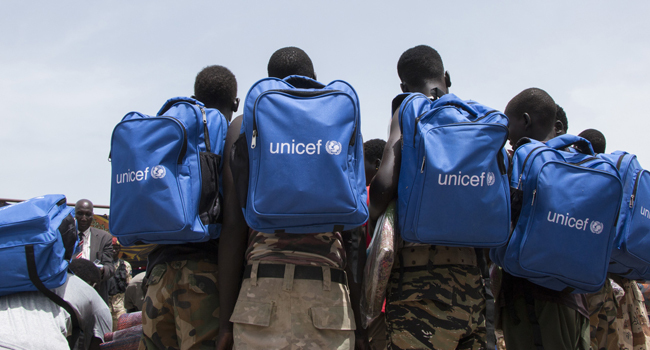
The Plateau State Government has raised concerns over the growing number of children outside the formal education system, revealing that 23.2 per cent of school-age children in the state are currently out of school.
To address the challenge, the government says it is strengthening community-based interventions and considering stricter measures to ensure that parents enroll their children in school.
The commitment was reiterated during an advocacy campaign on the activities of School-Based Management Committees (SBMCs), organised by the Plateau State Universal Basic Education Board (PLSUBEB) in Jos.
Speaking at the event, the Commissioner for Education, Kachollom Gang, described the out-of-school children crisis as a major threat to the state’s educational development, attributing the trend largely to insecurity and other socio-economic challenges.
“The issue of out-of-school children has become a menace. Insecurity is everywhere across the country, and it is increasing the number. The number of out-of-school children on the Plateau is growing, and we must tackle it,” she said.
Gang noted that Governor Caleb Mutfwang’s administration has invested significantly in the education sector but acknowledged that more effort is required to reverse the increasing dropout rate.
“The governor has done everything that needs to be done to encourage education in the state. I believe he will still do more because he is equally concerned about the rate of dropouts in our schools,” she added.
The commissioner commended SBMC members for supporting government initiatives and urged them to intensify sensitisation efforts within their communities.
....: Plateau APC Primary Officials Allege Pressure To Falsify PKK Election Record
“I want to appreciate our SBMCs all over the state because they are doing a lot to help us in the education sector. I appeal to you to go back to the grassroots because you are there with the children and you know those who are not in school,” she said.
She further disclosed that the ministry is exploring tougher policies aimed at compelling school attendance.
“As a ministry, we will have to come out with stringent rules that will encourage or force children to go back to school. We will work with traditional rulers, development partners and religious leaders to ensure that our children return to the classroom.”
Gang also lamented the decline in Plateau’s educational standing, recalling that the state was once regarded as a leader in education across Northern Nigeria.
“Gone are the days when Plateau State was the leading state in education in Northern Nigeria. When we came into office, Plateau was ranked 33rd out of the 36 states. We have climbed a little, and we are trying our best to return to where we used to be,” she stated.
Also speaking, the Executive Chairman of PLSUBEB, Sunday Amuna, stressed that addressing the out-of-school children crisis requires collective action from all segments of society.
“The advocacy is not only for people in government but also for traditional rulers, religious leaders and civil society to solve this challenge before us all,” he said.
Amuna warned that children who are denied access to education are more vulnerable to criminality and other social vices.
“Any child who is of school-going age and is not in school will definitely find something else to do, and that may not be good for society. That is why it is important that we collaborate through the SBMC.”
He called on communities to take greater responsibility for ensuring that children remain in school.
“If the local community decides that these are our children, and anyone who sends them to hawk, to mining, or any other activity can be sanctioned or prosecuted, I assure you we will get it right,” he said.
According to him, the state government and the Universal Basic Education Commission (UBEC) have earmarked resources under the Annual Basic Education Action Plan for the training and retraining of SBMC members to strengthen grassroots engagement.
“We believe that when the people at the grassroots are mobilised, we will achieve greater results. We will continue to do our best,” Amuna added.
UBEC’s Plateau State Coordinator, Esther Tells, described SBMCs as a vital bridge connecting schools, communities and government institutions.
“The School-Based Management Committee is a collaborative effort to bridge the gap between the school, the government and the local community to improve learning outcomes,” she said.
She highlighted the scale of Nigeria’s education challenge, noting that the country accounts for nearly one in five out-of-school children worldwide, with an estimated 18.5 million affected.
Providing state-specific data, Tells said Plateau’s out-of-school rate stands at 23.2 per cent, while school enrolment is estimated at about 65 per cent and the dropout rate exceeds 28 per cent.
“SBMCs can significantly reduce out-of-school children in Plateau State by bridging the gap between local communities and the education system,” she added.
Plateau State SBMC Chairman, Davou Terry, attributed much of the problem to insecurity, which he said has displaced many families and disrupted access to education.
“We went round the state because of the issue of out-of-school children. We found that the number is growing, and most of the children were displaced because of insecurity,” he said.
Terry also identified illegal mining, child labour and early marriage as major contributors to the rising number of children outside the classroom.
“Some of the children decided to join mining at a very tender age. Some girls got married early, while others were taken as house help,” he said.
He noted that SBMC members have continued to engage traditional and community leaders across the state to encourage school enrolment and retention.
“We talked to community leaders and encouraged them to speak to their people. We are appealing that it should not stop here. We will continue visiting communities and schools to ensure that more children return to the classroom.”
The advocacy campaign brought together government officials, education stakeholders, development partners, traditional rulers and SBMC members to explore strategies for reducing the number of out-of-school children and improving access to education across Plateau State.