
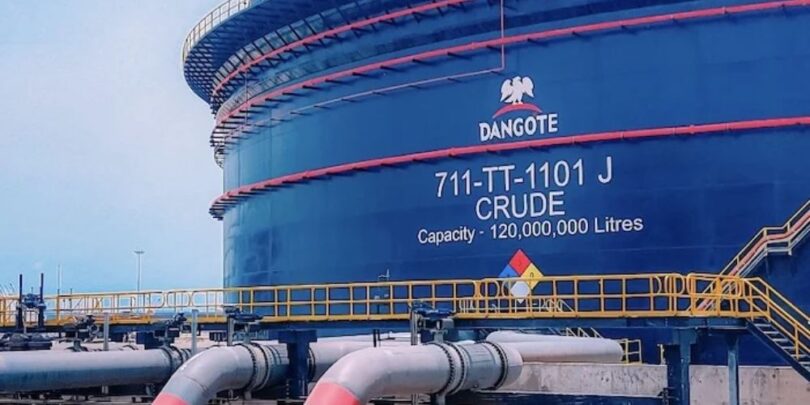
The refinery said the allegations lack support from available trade flow data and economic logic, stressing that it has no strategic or financial incentive to facilitate practices that would undermine its position as a leading supplier of petroleum products to the Nigerian market.
The refinery in a notice stated that one of its core objectives is to strengthen domestic fuel supply and reduce Nigeria’s dependence on imported petroleum products.
According to the company, enabling products refined at its facilities to be exported and later re-imported into the country would directly contradict that objective.
“Facilitating imports that compete directly with our own production would be inconsistent with our commercial interests,” the company said, adding that its sales contracts and tender agreements expressly prohibit buyers from reselling or re-importing its products into Nigeria.
Dangote Refinery also argued that the economics of such a trade route do not support the allegations.
The company estimated that transporting petroleum products from its refinery to Lomé and then shipping them back into Nigeria would attract logistics costs of between $82 and $90 per metric tonne.
It noted that such additional expenses would significantly reduce profit margins and make the transactions commercially unattractive.
According to the refinery, it does not provide export discounts large enough to offset the associated shipping, storage, financing and handling costs, thereby eliminating any viable arbitrage opportunity between export and domestic markets.
“There is no evident commercial incentive for a producer to incur substantial additional costs only for the product to return and compete in its largest and closest market,” the company stated.
The refinery further highlighted its product traceability systems and compliance mechanisms, noting that comprehensive records are maintained for all product sales.
These records include lifting locations, nominated vessels, counterparties and declared destinations where applicable.
Management said the suggestion that it knowingly supports product re-importation is inconsistent with its contractual restrictions, compliance procedures and monitoring systems.
The company also pointed to its long-standing public advocacy for increased local refining capacity and reduced fuel imports into Nigeria.
It argued that greater reliance on imported petroleum products would undermine domestic refining operations, place additional pressure on the country’s foreign exchange reserves and weaken industrial development efforts.
Dangote Refinery said its position has consistently been aligned with national efforts to achieve energy security and strengthen local value addition in the downstream petroleum sector.
The company maintained that the allegations are unsupported by market realities, contractual arrangements and operational controls, reiterating that there is neither a strategic rationale nor a commercial incentive for it to export products to neighbouring countries for eventual re-importation into Nigeria.
The clarification comes amid ongoing debates within Nigeria’s downstream oil sector over fuel supply chains, import dependence and the role of local refining in meeting domestic petroleum demand.