
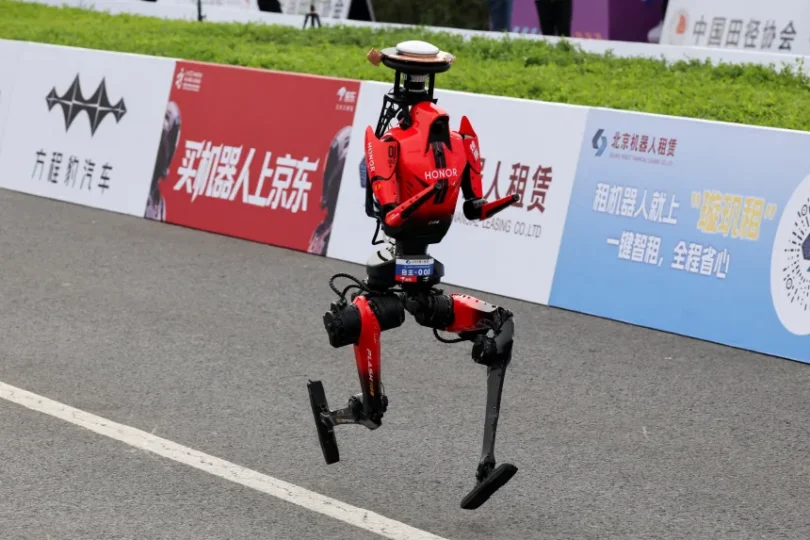
A humanoid robot has outpaced the humans at a half-marathon in Beijing, finishing faster than the previous human world record. According to France 24, the robot, named Lightning and developed by Chinese smartphone maker Honor, completed the 21-kilometre race in 50 minutes and 26 seconds on Sunday. The robot beat……
A humanoid robot has outpaced the humans at a half-marathon in Beijing, finishing faster than the previous human world record.
According to France 24, the robot, named Lightning and developed by Chinese smartphone maker Honor, completed the 21-kilometre race in 50 minutes and 26 seconds on Sunday.
The robot beat the human world record, which, according to World Athletics, was held by Uganda’s Jacob Kiplimo, who finished the same distance in about 57 minutes in March at the Lisbon road race.
According to the organisers, the performance by the robot marked a significant step forward from last year’s inaugural race, during which the winning robot finished in 2 hours, 40 minutes and 42 seconds.
The organisers also revealed that the competition, which was held alongside a race for humans, wasn’t without hiccups as one robot fell flat at the start line, and another bumped into a barrier.
Du Xiaodi, Honor’s test development engineer, said his team was happy with the results.
Du said its robot design was modelled on outstanding human athletes, with long legs of about 95 cm (around 37 inches), and was equipped with what he called a powerful liquid-cooling system, which was largely developed in-house.
“Looking ahead, some of these technologies might be transferred to other areas. For example, structural reliability and liquid-cooling technology could be applied in future industrial scenarios,” he said.
The organisers also noted that it will take time to achieve widespread commercialisation of humanoid robots, as spectators were already impressed by the robots.
A spectator, Sun Zhigang, told France 24 that he “feels enormous changes this year.”
Zhigang disclosed that he watched the race last year and watched Sunday’s race with his son.
Zhigang, “It’s the first time robots have surpassed humans, and that’s something I never imagined.”
Wang Wen, who came with his family, said robots seemed to have stolen much of the spotlight from human runners in the event.
“The robots’ speed far exceeds that of humans,” he said. “This may signal the arrival of sort of a new era.”
Beijing E-Town said about 40% of the robots navigated the course autonomously, while the others were remotely controlled.
State media outlet Global Times reported that a separate, remotely-controlled robot from Honour was the first to cross the finish line in 48 minutes and 19 seconds. But it said the winning one used autonomous navigation and received the championship under the event’s weighted scoring rules.
State broadcaster CCTV reported that the runners-up, which were also from Honor and used autonomous navigation, finished the race in about 51 minutes and 53 minutes, respectively. A robot served as a traffic officer to direct the participants with its arm gestures and voice, CCTV added.
In China, technology has evolved into an area of competition with the US, with national security implications.
Beijing’s latest five-year plan vows to “target the frontiers of science and technology.” Speeding up the development of products like humanoid robots and their applications is part of the 2026-2030 plan for the world’s second-largest economy.
London-based technology research and advisory group Omdia recently ranked three Chinese companies – AGIBOT, Unitree Robotics and UBTech Robotics Corp. – as the only first-tier vendors in its global assessment for shipment numbers for general-purpose embodied intelligent robots.
They all shipped more than 1,000 units of the robots last year, with the first two companies shipping more than 5,000 units, the report said.