
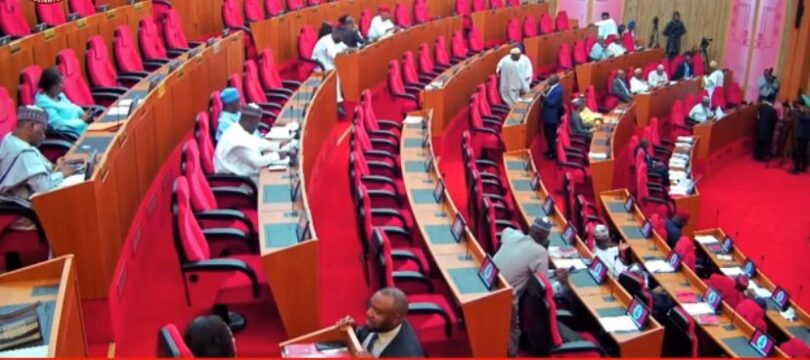
The committee’s action followed a petition submitted by an environmental activist, who raised concerns over the persistent refusal of some oil companies to fulfil their statutory obligations to the Niger Delta region.
The Senate Committee on the Niger Delta Development Commission (NDDC) has commenced an investigation into allegations that some international oil companies have failed to remit statutory contributions to the commission as required by law.
The committee opened the probe on Friday following a petition submitted by an environmental activist, Mathew Echo, who alleged that Aiteo Exploration and Production Company Limited, (now known as Nembe Exploration and Production Company Limited), owes the NDDC outstanding statutory remittances amounting to $71.65 million and N30.7 billion from 2021 to date.
During the hearing, the committee chairman, Asuquo Ekpenyong, assured stakeholders that the lawmakers would thoroughly investigate the allegations and engage all parties involved.
Mr Ekpenyong, who represents Cross River South Senatorial District, subsequently directed Aiteo Exploration and Production Company Limited to appear before the committee at its next sitting, scheduled to hold within two weeks.
He also directed the NDDC to submit a comprehensive list of oil companies that have failed to remit their statutory contributions to the commission, alongside details of efforts made to recover the outstanding funds.
The NDDC was established in 2000 to address the developmental challenges of the Niger Delta, Nigeria’s oil-producing region, which has long grappled with environmental degradation, poverty and inadequate infrastructure despite generating the bulk of the country’s oil wealth.
The Niger Delta region comprises nine oil-producing states in southern Nigeria which include; Abia, Akwa Ibom, Bayelsa, Cross River, Delta, Edo, Imo, Ondo and Rivers.
The NDDC is mandated to facilitate the rapid and sustainable development of the Niger Delta through the planning and implementation of projects in key sectors such as transportation, education, health, housing, electricity, water supply, agriculture and environmental protection. It is also responsible for coordinating development efforts among federal, state and local government agencies operating in the region.
Under the NDDC Act, the commission is funded through annual federal government allocations, contributions from oil-producing companies operating in the Niger Delta, ecological funds and grants. Specifically, oil companies are required to contribute three per cent of their annual operating budgets to the commission to support development projects and environmental remediation across the region.
The committee acted on the petition submitted by Mr Echo, who raised concerns over the persistent refusal of some oil companies to fulfil their statutory obligations to the Niger Delta region.
Section 2(p) of the NDDC Act requires oil-producing companies operating in the Niger Delta to contribute three per cent of their annual operating budgets to the commission to support infrastructure development, environmental remediation and other intervention projects.
Presenting the petition, Mr Echo said the continued failure of some oil companies to remit the required contributions has significantly undermined the NDDC’s capacity to carry out its developmental mandate.
He said the alleged non-remittance had persisted for decades, depriving the commission of critical funds needed to execute development projects across the region.
According to him, the funding gap has contributed to unpaid contractors, abandoned or stalled projects, and delays in environmental remediation efforts in the Niger Delta.
The petitioner urged the committee to investigate the matter and called on the Nigerian Upstream Petroleum Regulatory Commission (NUPRC) and other relevant regulators to enforce compliance, including imposing sanctions on defaulting companies.
The Managing Director of the NDDC, Samuel Ogbuku, acknowledged that several international oil companies had failed to remit their statutory contributions to the commission as stipulated by law.
Mr Ogbuku told the committee that the commission had held several engagements with the affected companies, particularly Aiteo Exploration and Production Company Limited, but the efforts had yielded little progress.
He warned that the funding shortfall had negatively affected the implementation of projects captured in the commission’s 2025 and 2026 budgets.
The NDDC boss, however, assured lawmakers that the commission would continue pursuing the recovery of all outstanding remittances.
During deliberations, members of the committee called for stronger enforcement measures against defaulting companies.
The senator representing Edo North Senatorial District, Adams Oshiomhole, proposed that formal summons be issued to the affected firms, compelling them to appear before the committee with documentary evidence of their remittance records.
Similarly, the senator representing Delta Central Senatorial District, Ede Dafinone, advocated stricter sanctions, including penalties for late payments and outright defaults.
Mr Dafinone, a member of the ruling All Progressives Congress (APC), also urged the committee to obtain a comprehensive list of all oil companies owing statutory remittances to the NDDC.