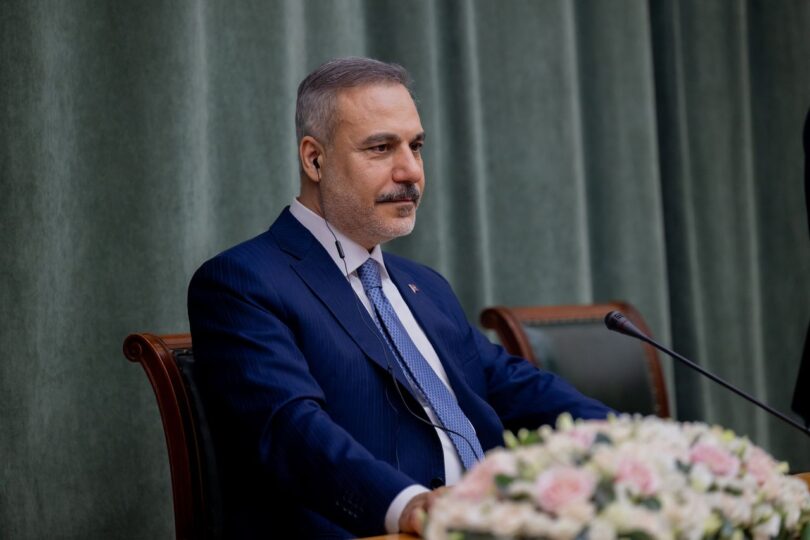
“There are very important issues, and it is not possible for them to be decided at a meeting where the US president is absent,” he said.
Fidan also said his talks in Russia showed there were no major disputes hindering bilateral relations or regional cooperation, with both countries seeking to expand collaboration. Mutual high-level visits continued and relations remained unchanged despite difficult issues being discussed openly, he added.
“We have developed a very special relationship with the Russians. Even when we have had very serious disagreements, we have known how to cooperate and build trust.
“Both leaders have a clear vision; they defend their countries’ interests within certain principles and are ready to adopt a constructive approach,” he said.
Related
Russia-Ukraine war and South Caucasus
On the Russia-Ukraine war, Fidan said Moscow’s position remained unchanged.
“During my meetings in Russia, I observed that Russian officials’ views on Ukraine have not changed. They say, ‘There is no chance of this happening until the Donetsk issue is resolved.'”
On South Caucasus, Fidan said the parties had agreed to activate the 3+3 regional platform involving Türkiye, Russia, Azerbaijan, Iran, Armenia and Georgia, describing it as an important mechanism for strengthening regional cooperation.
“As regional countries, we must prioritise cooperation instead of competition and the pursuit of dominance,” he said.
“With the same perspective, we can strengthen our economies and increase stability in the South Caucasus and Central Asia. The pursuit of domination must come to an end. Peace, tranquility and stability will benefit us all. We need to change our mindset.”
Despite persistent mistrust among some countries, the Turkish foreign minister said recent talks between Azerbaijan, Türkiye and Georgia had focused on connectivity, including the Middle Corridor, a transport route linking Europe and Asia via the Caucasus and Türkiye..
“We believe important steps can be taken,” he said.
On normalisation with Armenia, Fidan said Prime Minister Nikol Pashinyan’s government had taken important steps, while Türkiye had advanced measures, including direct trade and flights under President Recep Tayyip Erdogan’s leadership.
“We are ready for normalisation once the necessary conditions emerge,” he added.