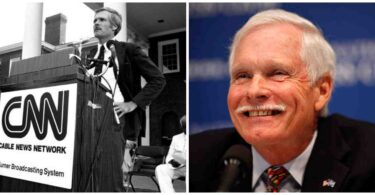
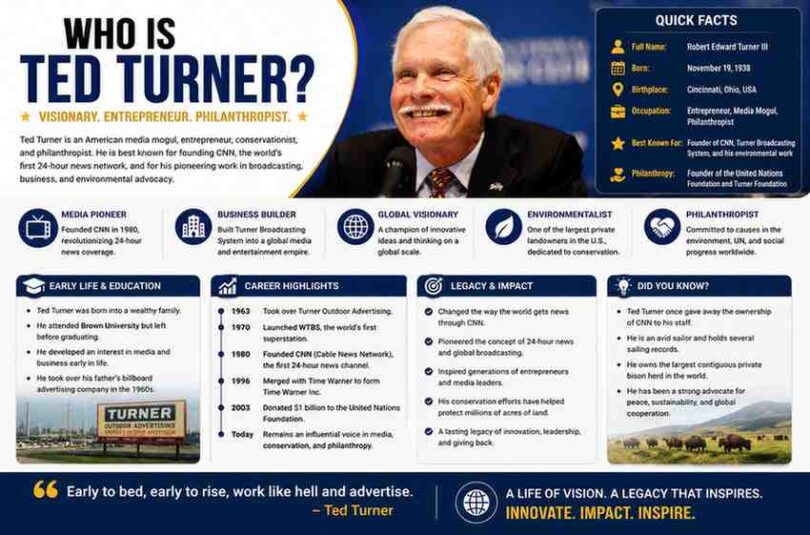
Ted Turner (November 19, 1938–May 6, 2026) was an American businessman, television producer, media proprietor, and philanthropist.
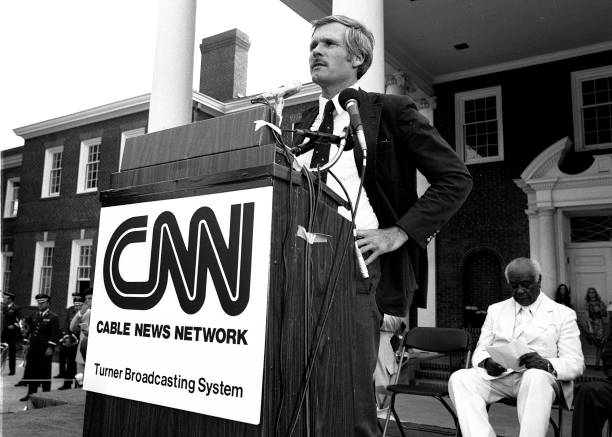
He established the Cable News Network (CNN), the first 24-hour cable news channel. He also developed WTBS, which pioneered the superstation concept in cable television, and the television network TNT.
Turner’s media empire began with his father’s billboard company, Turner Outdoor Advertising, which he took over in March 1963 when his father committed suicide. It was worth a million dollars.
His 1970 purchase of an Atlanta UHF station marked the beginning of the Turner Broadcasting System. He created CNN in 1980, which has since become one of the world’s most popular news networks.
Turner transformed the Atlanta Braves baseball team into a national sensation (winning the 1995 World Series under his ownership) and established the charity Goodwill Games.
He revived interest in professional wrestling by purchasing Jim Crockett Promotions, which was later rebranded as World Championship Wrestling.
Ted Turner Biography
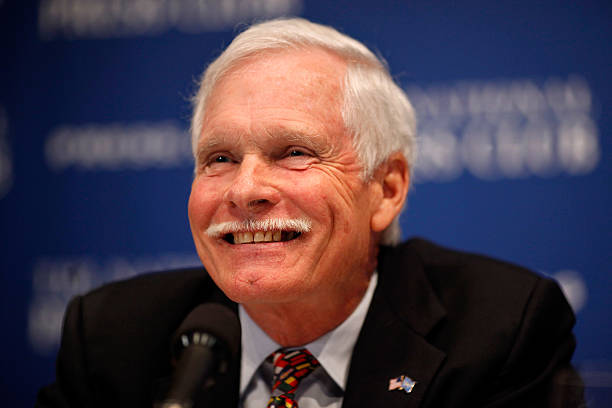
Robert Edward Turner III was born in Cincinnati, Ohio, on November 19, 1938, as the son of Florence (née Rooney) and billboard mogul Robert Edward Turner II. When he was nine, his family relocated to Savannah, Georgia, and he was raised as an Episcopalian.
He went to The McCallie School, a private boys’ preparatory school in Chattanooga, Tennessee. Turner attended Brown University, where he served as vice president of the Brown Debating Union and captain of the sailing team.
He became a member of Kappa Sigma. Turner initially majored in classics. Turner was expelled from Brown just as hostilities in Vietnam began to grow, so he joined the United States Coast Guard Reserve to finish his service duty before being drafted.
Career
Turner returned to the South in late 1960 after graduating from Brown University to take over as general manager of his father’s Macon, Georgia, branch. After his father committed suicide in March 1963, Turner took over as president and CEO of Turner Advertising Company at the age of 24 and transformed it into a global corporation.
In the late 1960s, Turner began purchasing several Southern radio stations. In 1969, he sold his radio stations and purchased Atlanta’s struggling television station, UHF channel 17 WJRJ-TV. At the time, UHF stations performed best in markets without VHF stations, such as Fresno, California, or in markets with only one VHF station.
Even in larger markets, independent UHF stations were not very popular or profitable, but Turner predicted that this would change as people desired more than a few options.
Initially, the station aired vintage movies from previous decades, as well as theatrical cartoons and reruns of sitcoms and drama shows. Turner would purchase better syndicated product for his station at a reasonable cost as it dropped off VHF stations.
The station initially struggled to the point where, in 1972, Turner appeared on the station to solicit viewer contributions; by 1975, the station was profitable and one of the most-watched independent stations in the nation.
In 1976, each of the station’s four-year contributors got checks that returned their money—with interest. WRET became Charlotte’s NBC affiliate in 1978.
In 1976, the Federal Communications Commission (FCC) authorised WTCG to deploy a satellite to deliver material to local cable television providers around the country.
On December 17, 1976, the rechristened WTCG-TV Super-Station began broadcasting vintage movies, situation comedy reruns, cartoons, and sports to cable subscribers across the country.
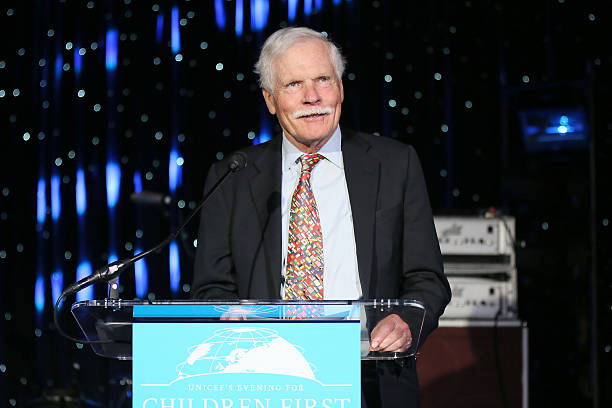
As cable systems expanded, many people carried his station to free up their schedules, increasing his viewership and advertising.
Turner’s net worth increased to $100 million once the number of subscribers reached 2 million. He purchased a 5,000-acre (2,000 hectare) estate in Jacksonboro, South Carolina, for $2 million.
Turner paid $50,000 to Technology Broadcasting System (now WMBR), a student-operated radio station at MIT, for the rights to the WTBS call sign in 1978. This action enabled Turner to boost the branding of his “Super-Station” by using the letters TBS.
Turner Communications Group became Turner Broadcasting System, and WTCG was renamed WTBS. Turner launched the Goodwill Games in 1986 to reduce tensions between capitalist and communist countries.
Broadcasting the events of these games also enabled his superstation to offer Olympic-style sports programming. In 1978, Turner approached media executive Reese Schonfeld about his plans to start a 24-hour news channel.
Schonfeld stated that it could be done with a 300-person team provided the newsroom was entirely electronic and all despatches were carried out via satellite.
It would require a $15 million to $20 million initial investment, as well as several million dollars every month in operating costs.
In 1979, Turner sold WRET-TV in Charlotte for $20 million, then a record price for a UHF television station, to fund the transaction, and moved its headquarters to lower-cost, non-union Atlanta. Schonfeld was chosen the first president and CEO of the Cable News Network (CNN).
CNN hired Jim Kitchell, former general manager of news at NBC, as vice president of production and operations; Sam Zelman as vice president of news and executive producer; Bill MacPhail as head of sports; Ted Kavanau as director of personnel; and Burt Reinhardt as network vice president.
After a disagreement over Schonfeld’s termination of Sandi Freeman, Turner replaced him as CEO in 1982, and Burt Reinhardt, CNN’s executive vice president, succeeded him as president.
Fabergé Cosmetics sold Brut Productions to Turner Broadcasting System in 1981. Following a failed attempt to acquire CBS, Turner paid $1.5 billion for Kirk Kerkorian’s film company MGM/UA Entertainment Co. in 1986.
Following the transaction, Turner accumulated massive debt and sold off portions of the deal; Kerkorian repurchased MGM/UA Entertainment. Lorimar/Telepictures purchased the MGM/UA studio lot in Culver City.
Turner retained MGM’s film and television catalogue from before May 1986 and prior to the merger. Turner Entertainment Co. was established in August 1986 to oversee Turner’s film and television properties acquired through the deal with Kerkorian.
In 1988, Turner bought Jim Crockett Promotions. He renamed it World Championship Wrestling (WCW), and it became the primary challenger of Vince McMahon’s World Wrestling Federation (WWF). This rivalry became known as the Monday Night War, and it lasted into the 1990s. The WWF purchased WCW in 2001 from AOL Time Warner.
Turner also launched Turner Network Television (TNT) in 1988 with Gone with the Wind.[52] TNT began with airing older movies and television episodes, but later included original programmes and current reruns.
Turner later founded Turner Classic Movies (TCM) in 1994, which aired Turner’s library of pre-1986 MGM films, Warner Bros. films created before 1948, and all RKO films, as well as licensed 1,000 additional films.
Ted Turner Wife
Turner married and divorced three times: to Judy Nye (1960-1964), Jane Shirley Smith (1965-1988), and actress Jane Fonda (1991–2001).
Ted Turner Children
He has five children. In a television interview with Piers Morgan on May 3, 2012, Turner said that he had four girlfriends, which he admitted was difficult but simpler than marriage.
Death
Turner confirmed his Lewy body dementia diagnosis during an appearance with CBS Sunday Morning in 2018. In an interview with Atlanta Magazine, Ted’s former wife Jane Fonda stated that by making his disease management public, many more people will be able to learn about it.
Turner was admitted to the hospital in January 2025 for pneumonia and later recovered at a rehabilitation facility.
Turner, 87, died at home in Lamont, Florida, on May 6, 2026.
Ted Turner Net Worth
According to Forbes, Turner’s net worth as of May 6 was $2.3 billion, ranking him 1,504th among the world’s richest billionaires. While Turner is best known as a media magnate and the founder of the 24-hour news cycle, much of his riches later came from massive property holdings, making him one of the wealthiest private landowners in the United States. His fortune reportedly peaked at $10 billion before plummeting dramatically following the AOL-Time Warner merger.