
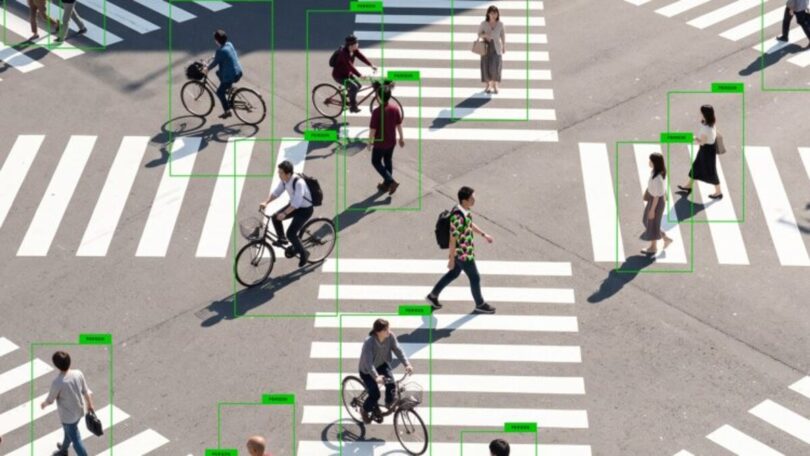
German artist Simon Weckert has created a colourful shirt designed to confuse AI-powered surveillance cameras.
The shirt is called Digital Camouflage.
Its bright pink, orange, green and black pattern looks like an unusual Hawaiian shirt.
However, Weckert did not choose the pattern for fashion.
He designed it to prevent certain AI object-detection systems from recognising the wearer as a person.
AI camera systems do not understand humans in the same way people do.
They search for visual features such as a person’s head, shoulders, arms, body shape and outline.
The shirt’s pattern breaks up those visual features. This can reduce the system’s confidence until it stops identifying the wearer as human.
Weckert used AI to develop the design through a process called an adversarial loop.
He created a pattern, tested it against a person-detection system and measured whether the system could still find the wearer.
He then adjusted the design and repeated the test until the detection system failed.
This means AI helped create clothing designed to confuse another AI system.
Photos from the experiment show green boxes around pedestrians detected as people. The camera does not place a box around the person wearing the Digital Camouflage shirt.
Weckert developed the project in response to the growing use of automated surveillance systems in public places.
He documented the shirt at Kottbusser Tor in Berlin, where authorities have introduced AI-assisted video monitoring.
However, the shirt does not make its wearer physically invisible.
It was tested using YOLO, a generic open-source object-detection system.
There is no independent proof that it works against every AI camera, facial-recognition system or government surveillance network.
Different systems use different technology. Software updates could also teach a detection system to recognise the pattern.
Weckert said the design is not meant to help people escape police detection or guarantee anonymity.
He created it to encourage discussion about privacy and the growing use of machines to monitor people in public spaces.
A share of the money raised from shirt sales will support organisations protecting digital rights and opposing excessive surveillance.