Advertisement
Advertisement
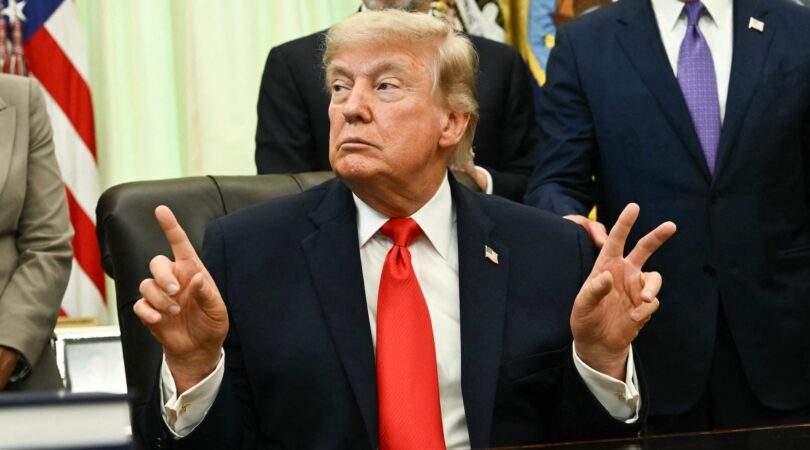
U.S. President Donald Trump has approved a landmark nuclear deal with Saudi Arabia which would potentially pave the way for uranium enrichment on Saudi soil.
According to U.S. media reports, the Wall Street Journal, citing government officials, the deal would help the kingdom build a civilian nuclear programme.
The multibillion-dollar agreement is said to have a duration of 30 years, secure a key role for U.S. companies in building Saudi Arabia’s nuclear infrastructure and exclude other foreign competitors.
A central provision foresees U.S. companies building a uranium enrichment facility in Saudi Arabia, provided a joint U.S.-Saudi study concludes that such a step is justified.
The Trump administration reportedly considers that this partnership would give the U.S. influence over the Saudi nuclear programme while ensuring it would not be misused for military purposes.
The agreement, which is to be submitted to Congress in Washington for review in the coming days, is expected to face resistance, as many lawmakers oppose the spread of nuclear technology in the politically volatile Middle East.
The New York Times reported, citing government officials, that Trump had been forced to make compromises to reach the agreement.
He had agreed to conditions that could potentially prevent international inspectors from gaining access to certain sites, specifically those where there is suspicion that nuclear fuel could be diverted for weapons programmes, the newspaper said.
U.S. Energy Secretary Chris Wright already held talks on such a deal during a visit to the region in April 2025. At the time, speculation was already swirling about a possible new energy agreement between the two countries that could pave the way for a nuclear programme in the desert kingdom.
The U.S. previously held talks with Saudi Arabia on a possible normalisation of bilateral relations with Israel. In return, support for Riyadh on its nuclear programme and a possible new security agreement had been discussed.
However, the Saudi-Israeli normalisation process was frozen after the outbreak of the Gaza war at the end of 2023.
Saudi Crown Prince Mohammed bin Salman, the kingdom’s de facto ruler, has continued to express his country’s “great interest” in developing a civilian nuclear programme.
In a 2018 interview with CBS, he said Saudi Arabia would pursue nuclear weapons “as soon as possible” if Iran acquired them.
Saudi Arabia and Iran have long competed for regional influence. Although the two countries restored diplomatic ties in 2023 under a Chinese-brokered agreement, deep mistrust remains after decades of geopolitical rivalry, much of it shaped by the Sunni-Shia divide.
Dpa/NAN