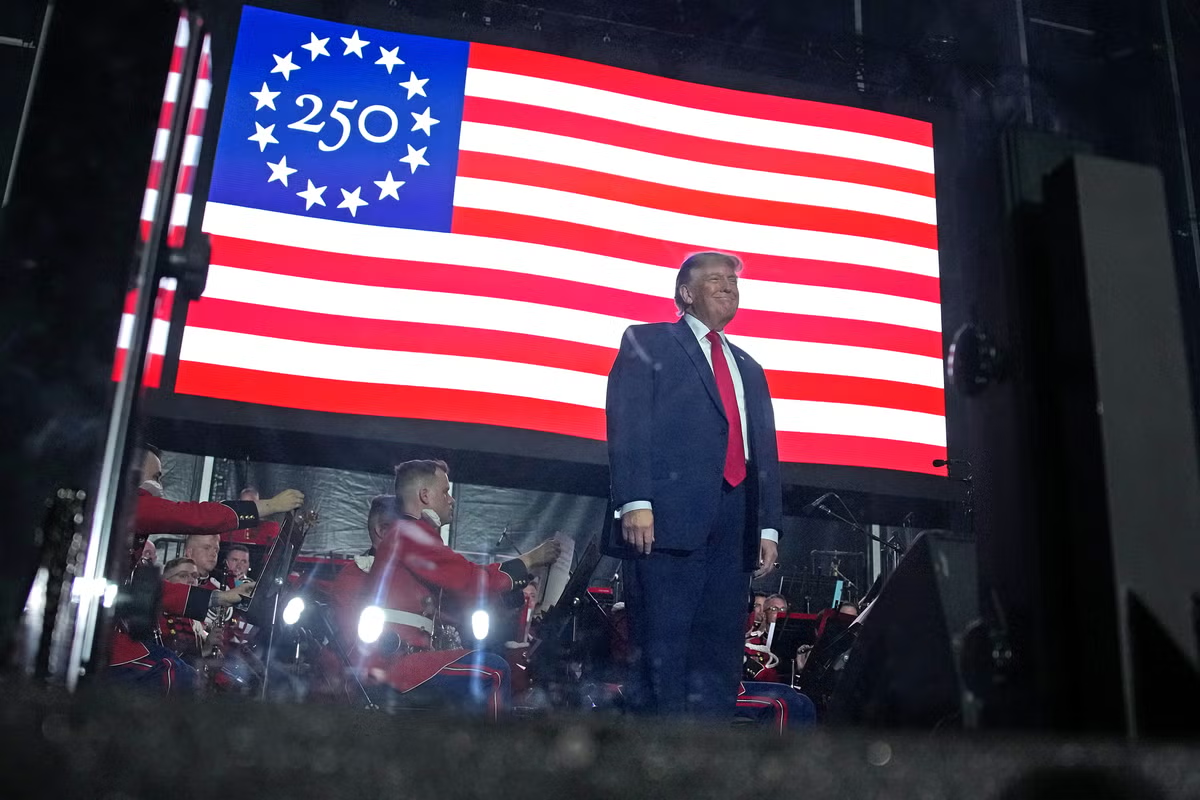
When Donald Trump steps on stage to celebrate America’s 250th anniversary, he will possess more presidential power than any of his predecessors in generations. That power, according to legal scholars and several Supreme Court justices, goes beyond the scope of the monarchy from which Americans fought to liberate themselves.
Empowered by a Supreme Court increasingly drawn into his administration’s legal crusades, and unmoored from a Republican-controlled Congress uninterested in checks and balances, the president enters the next chapter of U.S. history testing how far the country has come since then.
Across dozens of legal challenges against him, the administration has deployed a legal theory that effectively grants the president virtually limitless authority across the government.
In one of its final actions of this year’s term, the Supreme Court appeared to endorse that “unitary executive” theory, which the president believes gives him absolute control over the executive branch and its dozens of government institutions and millions of employees.
The landmark decision in Trump v Slaughter could open the door for the president to direct federal law enforcement to prosecute his enemies with impunity, bend independent agencies to his will, and launch military actions without congressional approval. At bottom, Trump is expected to continue his seizure of supposedly independent agencies to chase his own priorities instead.
Trump, whose face is currently pictured on massive banners draped over government buildings across Washington, D.C, returned to the White House last year armed with the tools and chief aides to implement sweeping plans to remake the presidency around himself.
Failing to ram a bulk of his agenda through a Congress, the president instead issued a wave of executive orders giving him the illusion of supreme authority while daring critics to challenge him with lawsuits that have stress-tested the Constitution.
Trump’s attempts to rule by fiat have been met with mixed results in court. He has cast the judges who rule against him — including his own appointees — as corrupt, impeachable or criminal, while he remains incredulous that anyone could dare strike down a command from the executive branch.
After he fired a Democratic appointee to the Federal Trade Commission last year, the Supreme Court’s conservative justices overturned a nearly century-old precedent that states that Congress — not the president — limits the president’s power to fire the heads of independent regulatory agencies.
With that decision, the court unleashed more presidential power under Trump, who appears to have the Supreme Court’s blessing to fire independent appointees who won’t do what he wants and return the government to a spoils system that rewards cronies.
“The court gives the president a power unknown even to the English Crown against which the Founders revolted,” wrote liberal Justice Sonia Sotomayor, whose dissent was joined by Justices Elena Kagan and Ketanji Brown Jackson.
In 2024, the same conservative majority granted Trump sweeping immunity from criminal prosecution for actions tied to his “official” duties in office, a decision that doomed criminal cases against the president.
With its latest ruling expanding the scope of presidential power, the conservative justices embraced a “half-baked theory of executive power” that guarantees “chaos” will follow, according to Sotomayor.
“The result is a President who emerges with far greater power than ever before. It is a power, however, that neither the People, nor Congress, nor the Constitution bestowed upon him,” she wrote. “In granting the President this unbridled authority, the Court upends its precedent, misconstrues our history, and sheds any pretense of judicial modesty.”
Last year, Justice Jackson accused the court’s conservative justices of contorting the law in a series of rulings to ensure Trump “always wins.”
“This is Calvinball jurisprudence with a twist,” wrote Jackson, referring to a game from the comic strip Calvin and Hobbes. “Calvinball has only one rule: There are no fixed rules. We seem to have two: that one, and this administration always wins.”
In remarks from North Dakota on Wednesday, Trump said the decision “gives power back to the president at a time when the president really needs power.”
“This Decision gives tremendous additional Power back to the Presidency, where it belongs,” he also wrote on Truth Social.
Slaughter, the fired FTC commissioner at the center of the case, said the ruling made her “sad for America.”
“I’m very worried about a future where presidents, like President Trump, can wield this enormous grant of executive power that the Supreme Court just handed to him in order to reward his friends and punish his enemies and do so with impunity,” she told MS NOW.
Alix Fraser, vice president of advocacy for campaign finance reform organization Issue One, said the decision “opens the floodgates for more governing decisions based on the president’s whims and self-interest.”
“This decision contributes to a decades-long trend of Democratic and Republican presidents consolidating the powers that the Constitution grants to Congress,” she said. “The Constitution emphasizes separation of powers to ensure that no one branch of government is beyond reproach or accountability. The court’s ruling … undermines that balance instead of reasserting it, concentrating even more power in the president’s hands.”