
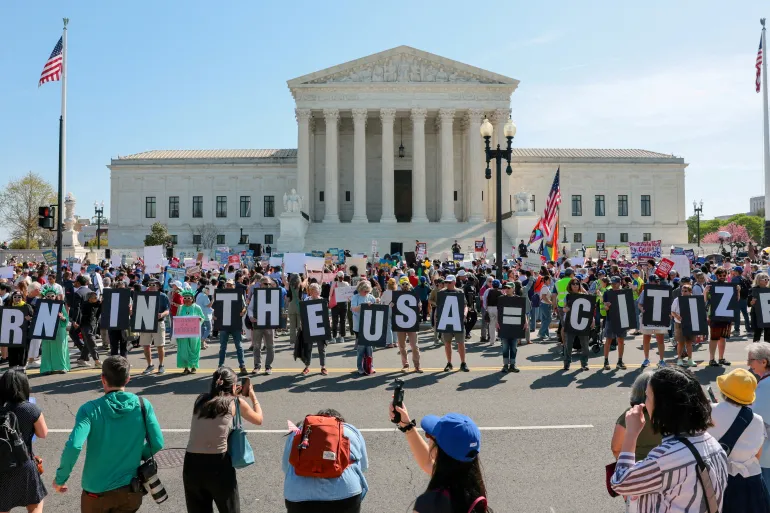

United States President Donald Trump has announced plans to request that the US Supreme Court rehear a major immigration case after the court recently struck down his executive order aimed at ending automatic birthright citizenship.
The high court rejected the administration’s attempts to restrict the long-standing practice, but the president maintained that he will immediately petition for a formal rehearing.
Taking to his social media platform, Truth Social, the president on Thursday, strongly criticized the decision, asserting that American citizenship is not something to be compromised and declaring the high court’s legal conclusion fundamentally wrong.
The 6–3 ruling against the administration’s directive delivered a substantial setback to the executive branch’s efforts to overhaul national immigration policy. Upon taking office on January 20, 2025, President Trump had signed an executive order designed to prevent children born in the US to parents on temporary legal statuses or without legal documentation from automatically acquiring American citizenship.
Following the judicial defeat, the president characterized the outcome as detrimental to the country and urged congressional lawmakers to pursue legislative restrictions. However, that path faces steep hurdles, given consistent public support for birthright citizenship and the court’s written opinion suggesting that any structural change would require a full constitutional amendment.
Legal analysts note that the administration’s chances of securing a new hearing remain exceedingly low. The Supreme Court rarely grants petitions for rehearing, and several decades have passed since the court last allowed a retrial after a final ruling had been officially issued in an argued case.
The administration has pursued a wide-ranging overhaul of nearly all facets of US immigration since early 2025. While the birthright citizenship directive was struck down, the federal government recently secured several other judicial victories regarding immigration enforcement.
These included court clearances allowing the executive branch to phase out Temporary Protected Status (TPS) designations for nationals of certain crisis-hit countries, alongside the implementation of strict border enforcement measures designed to prevent asylum seekers from entering US territory to initiate protection claims.
Nevertheless, the Supreme Court drew a firm line regarding birthright citizenship, ruling that the administration’s executive order directly violated the explicit language of the Fourteenth Amendment of the US Constitution, which confers automatic citizenship upon individuals born in the United States and subject to the jurisdiction thereof.
Civil rights organizations strongly praised the judicial decision, noting that it reaffirms a foundational constitutional promise regarding equality of birth. Conversely, policy research data highlighted the potential long-term demographic impacts had the executive order stood.
A joint study by the Migration Policy Institute and Penn State University projected that the restriction would have resulted in an estimated 255,000 infants being born annually without legal status, potentially expanding the undocumented population by 2.7 million residents by 2045 and creating a complex, multigenerational legal underclass within the country.