
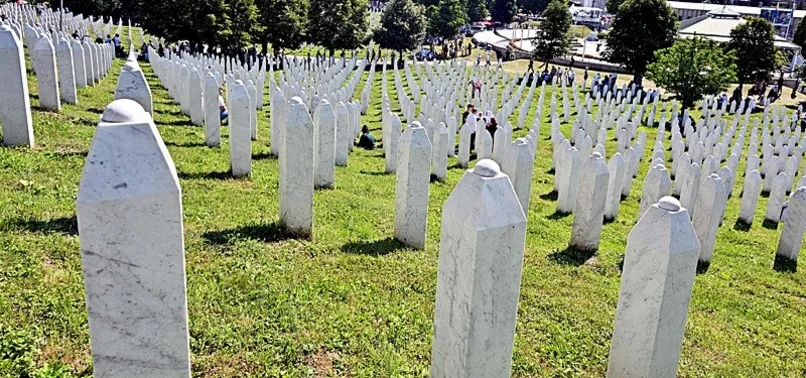
The Turkish Foreign Ministry on Monday held a Srebrenica genocide commemoration ceremony in Ankara to mark the 31st anniversary of the genocide.
The event, held at the ministry, was attended by Deputy Foreign Minister and Director for EU Affairs Ambassador Mehmet Kemal Bozay, as well as Bosnia and Herzegovina‘s Ambassador to Ankara Mirsada Colakovic.
Speaking at the ceremony, Bozay noted that on May 23, 2024, the UN General Assembly designated July 11 as the International Day of Reflection and Commemoration of the 1995 Genocide in Srebrenica.
Bozay also noted that, under a presidential circular, July 11 is observed in Türkiye as Srebrenica Genocide Remembrance Day and that commemorative ceremonies have been held at the ministry since 2024.
He said the participants had gathered to preserve the truth, support the pursuit of justice, and pass on to future generations a memory entrusted to humanity’s collective conscience.
“The Srebrenica genocide is one of the darkest chapters not only in the history of Bosnia and Herzegovina, but also in the shared memory of Europe and all humanity,” Bozay said.
He said the atrocity committed on July 11, 1995, in a city declared a UN safe area in the heart of Europe, demonstrated the destructive consequences of hatred, discrimination, and extreme nationalism.
Bozay underlined that, according to the rulings of the International Court of Justice and the International Criminal Tribunal for the former Yugoslavia, what happened in Srebrenica was legally and indisputably genocide.
He said denying this truth or presenting it as a “symbolic victory” harmed humanity’s collective conscience.
“The newly identified victims buried in Potocari every year remind us once again that justice, even when delayed, remains a responsibility that must never be abandoned,” he said.
Referring to rising hate speech, xenophobia, Islamophobia, and ethnic discrimination in different parts of the world, as well as what he described as the genocide being witnessed in Gaza, Bozay said humanity had failed to draw the necessary lessons from the past.
“Türkiye continues to regard peace in Bosnia and Herzegovina as one of the main pillars of stability in the Balkans. Our support for Bosnia and Herzegovina’s sovereignty, territorial integrity, and constitutional order is principled and unwavering,” Bozay said.
He added that Türkiye was closely following recent developments in the country that had complicated the functioning of state institutions, challenged the constitutional order, and damaged public trust.
Bozay warned that divisive rhetoric, unilateral steps, and attempts to gain political benefit from the wounds of the past served no one’s interests.
He stressed that Bosnia and Herzegovina did not need new divisions, but stronger institutions, greater dialogue, and reinforced mutual trust.
– Perpetrators presented as heroes
Ambassador Colakovic also expressed Bosnia and Herzegovina‘s gratitude to Türkiye.
“I would like to convey my deepest gratitude to the Republic of Türkiye for its principled and determined support for Bosnia and Herzegovina,” she said, adding that the joint commemoration of the Srebrenica Genocide was one of the most meaningful examples of that support.
Colakovic noted that more than 8,000 people were killed in Srebrenica 31 years ago simply because they were Bosniak Muslims, despite the town having been declared a UN safe area.
“As the men and boys of Srebrenica were placed on buses and taken into the forests to be systematically executed, the leaders of the world’s powerful countries remained silent. The world watched what was happening in silence,” she said.
Colakovic said the families left behind lost not only their relatives, but also their faith in the ability of international law to protect those most in need.
She underlined that the Srebrenica genocide had been confirmed by thousands of pieces of evidence, witness accounts, forensic examinations, and DNA analyses.
Colakovic also criticized efforts to portray the perpetrators as “heroes” and to build monuments in their honor. She said so-called academic studies had been published with the aim of downplaying the scale of the crime.
“Genocide denial is not freedom of expression; it is the continuation of the crime by other means,” Colakovic said.
She underscored that no crime could become a source of political pride and that no court ruling could be changed through propaganda.