By MUSTAPHA MUSA
Societies are governed by laws. Laws create institutions, set boundaries for them, define relationships between the various arms and tiers of government, and regulate their conduct. In addition, they delegate responsibilities to both governments and the governed. Above all, laws provide the legal backbone for delivering the dividends of democracy to the citizenry.
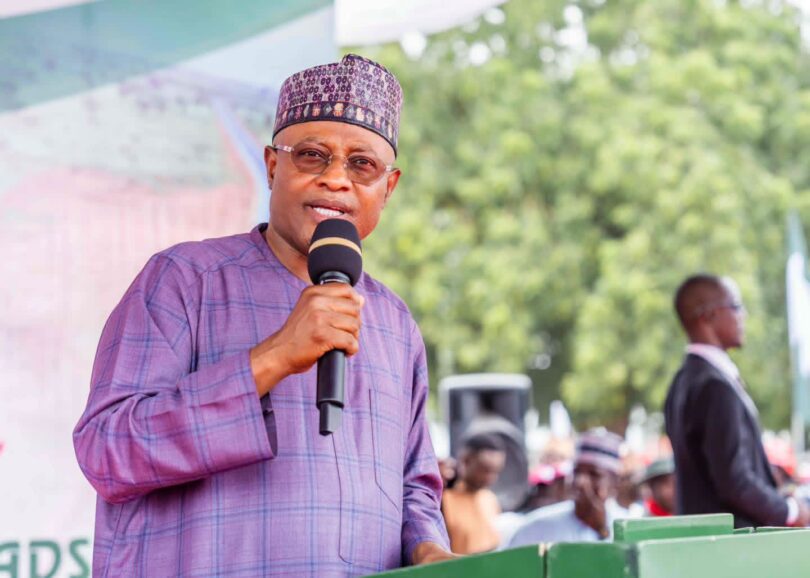
Senator Uba Sani, the Executive Governor of Kaduna State, is conversant with the law and all its ramifications. First, he was a civil rights and pro-democracy activist, where he kept constant vigil over how laws were either used or abused during the military era. Thereafter, he threw his hat into the ring as a Presidential Adviser and Political Adviser at different times, where he occupied a ringside seat at the centre of power. Afterwards, he went to the Senate, the upper legislative chamber where laws are made.
In 2023, the people of Kaduna State voted for him to practise what he had been preaching about due process and the rule of law. In the last three and a half years, the Comrade-Governor, as some analysts like to call him, has assented to 32 laws spanning security, education, healthcare and agriculture. In addition, some of the laws cover infrastructure, social protection, technology, public finance, electricity regulation and climate change.
Since assuming office in May 2023, His Excellency, Senator Uba Sani, CON., has used executive assent not merely as a constitutional formality, but as an important instrument for translating policy priorities into durable legal and institutional frameworks.
Securing Kaduna State
Significantly, security has remained a central priority of the administration, reflecting the Governor’s position that sustainable development cannot be achieved without peace and public safety. In this regard, the administration has strengthened the Kaduna Vigilance Service (KADVS) by recruiting and training 7,000 personnel. Besides, it has provided security agencies with 150 Hilux vehicles and 500 patrol motorcycles. The Governor has also constructed Kaduna State’s first forensic laboratory and training centre.
Beyond security logistics, the administration has pursued dialogue and community-based peacebuilding to address the security challenges bedevilling some parts of Kaduna State through the Kaduna Peace Model. At the heart of this model is a shift from reaction to prevention, strengthening institutions, empowering local actors, and creating channels through which grievances can be addressed before they escalate. The model also promotes engagement between communities and security agencies, encourages interfaith and intercultural dialogue, and provides opportunities, especially for young people, to contribute meaningfully to their society.
As a result of these engagements, the security situation in Birnin Gwari, Chikun, Giwa, Igabi, Kachia, Kajuru and Kagarko has improved. By April 2026, the Governor stated that public confidence was gradually returning and economic activities were expanding in areas previously considered inaccessible. The statutory framework supporting this broader security architecture complements the administration’s investments in security institutions, community engagement and emergency response.
Transforming Rural Areas, Strengthening Urban Renewal
Apart from the Kaduna Peace Model, Governor Uba Sani’s Rural Transformation agenda has been winning hearts and minds both within and outside Kaduna State. As of 2026, Governor Uba Sani has initiated and executed approximately 150 road projects, covering more than 1,300 kilometres across the 23 local government areas. The projects include urban roads, rural access roads and strategic links intended to connect communities, agricultural production centres and markets.
In fact, his administration has constructed the single longest road in the history of Kaduna State, the Gadan-Gayam–Gwaraji–Kujama road network, which connects approximately 76 farming communities across three local government areas: Igabi, Kajuru and Chikun.
Indeed, there were 12 local government areas that had not benefited from a single kilometre of road before the coming of this administration.
Education for All, Enhancing Human Capital
In Kaduna State, Governor Uba Sani often says that education is a right and not a privilege. In this regard, he has been walking his talk, with emphasis on human capital development. As of last April, his administration had constructed 736 new classrooms and renovated more than 1,200 existing classrooms, while recruiting 10,000 new teachers and training more than 33,000 education personnel in modern teaching methods and digital skills.
The administration has also recorded substantial progress in tackling the out-of-school children crisis. The number has fallen from approximately 550,000 to 187,720. Simultaneously, Governor Uba Sani has strengthened secondary and tertiary education. New secondary schools and science schools have been established, while existing ones have been renovated and upgraded.
In fact, one of the first Executive Orders he signed as Governor, in August 2023, was the reduction of tuition fees in state-owned tertiary institutions. This has increased student enrolment in tertiary institutions.
At Kaduna State University (KASU) alone, Governor Uba Sani has released over ₦800 million for staff welfare, in addition to ₦146 million to clear withheld salaries and outstanding SIWES allowances inherited from previous administrations. In 2026 alone, the Government further disbursed over ₦200 million in overhead funding to support day-to-day operations, including laboratory chemicals and reagents, students’ field trips, examinations and other essential academic activities.
The present administration has equally invested over ₦300 million in the accreditation of more than 57 academic programmes and resource-verification exercises for 60 postgraduate programmes by the National Universities Commission (NUC).
Training Artisans, Developing Skills
Apart from formal education, Governor Uba Sani has invested in skills-based education to boost human capital development in Kaduna State. He has established the Institute of Vocational Training and Skills Development, with campuses at Soba, Rigachikun and Saminaka, covering the Northern, Central and Southern Senatorial Districts, respectively.
Tinubu to govs: Emulate Uba Sani on mass transit scheme
The Institute focuses on practical skills in areas including ICT, mechatronics and renewable energy, thereby linking education more directly with employment, entrepreneurship and emerging industries.
Recently, the Institute graduated more than 4,000 artisans and tradespeople, a bold step towards reducing unemployment and enhancing human capital development. In addition, the Governor gave the graduates ₦200,000 each, amounting to ₦810 million, to ease their transition from training to productive work.
Giving Healthcare a Lease of Life