
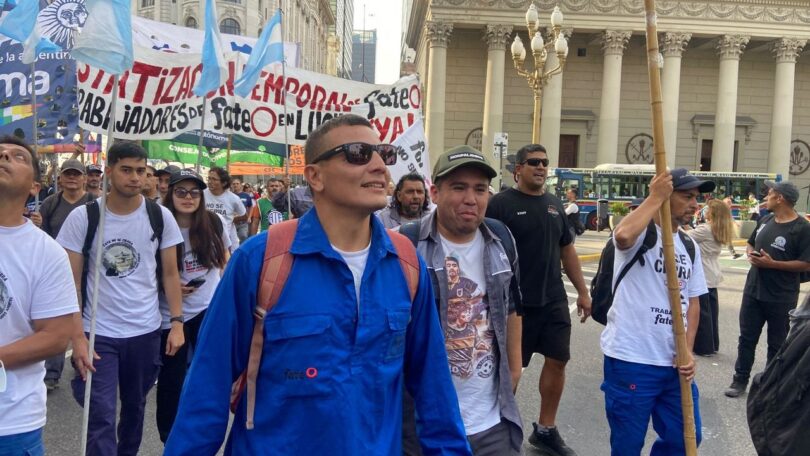
Sebastián Tesoro worked for 12 years in the sorting department at Fate, a tyre factory in Argentina that produced more than 7,000 tyres a month for cars and trucks.
In its heyday, the company shipped around five million tyres a year. But in February, it decided to close its doors, laying off 920 employees, including Sebastián.
On February 18, when Tesoro arrived at the factory — located on a 40-hectare site 30 kilometres from downtown Buenos Aires — he found a sign that read: “Fate announces that, as of today, it is ceasing operations at its industrial plant.”
The company, with an 80-year history, was the only domestic tyre producer.
“I felt angry, but not resigned. The first thing that came to mind was to protest. I couldn’t go home resigned; I have three children, work-related illnesses, and colleagues who can’t afford to lose their health insurance,” Tesoro told TRT Español.
The industry is in critical condition
Like Sebastián, Argentina has lost 300,000 registered jobs since Javier Milei took office, according to data from the National Labour Secretariat. During the same period, more than 22,000 businesses closed, according to official records.
Thus, the once-thriving Argentine industry, which was the country’s productive engine, is now undergoing a critical period and a profound structural transformation, according to official reports, businesspeople, and experts, due to the opening of imports and the increase in public utility rates.
Related
A report from the University of Buenos Aires warned that 100,000 jobs were lost in the industrial sector over the past two years, at a rate of 160 per day, while idle factory capacity rose by 40 percent.
Overall, companies’ installed capacity (the maximum volume of production or services a company can provide) averaged 54.9 percent.
President Javier Milei is pushing for economic reforms amid changes in Argentina’s industrial sector.
Since coming to power, President Javier Milei has boasted about the shift he intended to bring to the productive sector, prioritising primary activities such as oil extraction and agriculture over productive industry, which he discouraged by opening up to imports.
“To protect industry, the agricultural sector was robbed, and all that was created was a sector addicted to the state,” Milei declared. For the president, the pillar of growth “comes hand in hand with trade liberalisation”.
“For almost a century, Argentina has been trapped in the trap of industrial fetishism. We were told that the only way to generate employment was to maintain a heavily subsidised industrial system,” he stated in March.
He also recently stated that “economic activity has begun to rebound” and “revive.” “We are seeing record exports, investments are coming in, credit is growing strongly, and we are beginning to rebuild working capital,” Milei asserted.
“The economy will return to a path of growth,” he emphasised at a meeting organised by the American Chamber of Commerce in Argentina.
“The industrial sector is the biggest loser in the productive restructuring that Argentina is undergoing,” Federico Machado, a professor of Microeconomics at the National University of La Plata and member of the Observatory of Policies for the National Economy, told TRT Español.
‘Complicated situation’
While some economic variables have improved, such as inflation, which fell from 211 percent in 2023 to 32.6 percent in the last 12 months, and sectors that reported upturns, such as mining, energy and financial intermediation, others are plummeting, according to official records, including the textile and clothing industry, chemicals and the manufacture of machinery, tools and industrial vehicles, among others.
As a result, layoffs have increased over the past year, and these have not been offset by growth in other sectors. According to the National Institute of Statistics and Censuses, unemployment rose to 7.5 percent at the end of 2025, according to the latest official report.