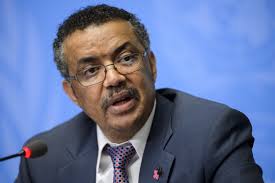
Dr Tedros Ghebreyesus, Director-General of the World Health Organisation (WHO), has told communities in Bunia that community ownership will be key to ending the Bundibugyo Ebola outbreak.
In a statement made available on Saturday, Ghebreyesus spoke during a media conference in Ituri, emphasising the importance of local participation in controlling the disease.
The statement quoted Ghebreyesus as saying he was not in the Democratic Republic of Congo (DRC) to dictate orders but to listen and support solutions developed by communities themselves.
“We are here to work under the leadership of the government of DRC, in service of its people,” he said.
Ghebreyesus said the outbreak was DRC’s 17th Ebola epidemic and was caused by the Bundibugyo virus, one of six known Ebola species.
He said that no licensed vaccine or treatment currently existed for the strain.
The WHO chief said people infected with Bundibugyo Ebola could survive with proper medical care, adding that some patients in Ituri had already recovered.
He advised anyone experiencing symptoms to seek medical attention early, stressing that timely treatment could significantly improve outcomes.
He was quoted as saying he would spend two days meeting women’s groups, religious leaders, business leaders and young people across Bunia to build trust and strengthen community engagement.
“Earlier on May 30, he met DRC ministers, the Ituri governor, the Congolese Red Cross, community leaders, Africa CDC, UNICEF and WFP.
“On May 29 in Kinshasa he met Prime Minister Judith Tuluka.
“She committed to ensuring response investments strengthen DRC’s health system long after Ebola ends.
“What we build here should last well beyond this outbreak,” the WHO Director-General said.
Ghebreyesus said WHO and its partners were prioritising hand hygiene, the dissemination of accurate information and safe, dignified burials as part of the response strategy.
He acknowledged the pain of losing loved ones and the importance of burial rites to families and communities.
However, he warned that touching the bodies of people who died from Ebola could further spread the virus.
“While we grieve for those we have lost, we must do everything we can so that we do not lose another,” he said.
According to him, the response effort extends beyond Ebola containment alone.
He pledged to ensure the continuation of essential health services and humanitarian assistance across Ituri and other affected areas during the outbreak.
“The UN Country Team, health and humanitarian partners, and the diplomatic corps are all coordinated under government leadership,” he said.
Ghebreyesus said that DRC had successfully overcome 16 previous Ebola outbreaks, expressing confidence that the country could end the current epidemic.
He said the country’s track record provided WHO with confidence in its ability to contain the 17th outbreak.
He also urged countries that had imposed travel bans or border closures to reconsider, saying such measures complicate response efforts and discouraged transparency.
According to him, WHO’s commitment will
continue even after the outbreak has been declared over.
“The goal is to leave behind health workers, hospitals, laboratories and services that will serve Ituri for years.
“We are here, we are with you, and we will see this through together. You are not alone,”he said.
(NAN)