Advertisement
Advertisement
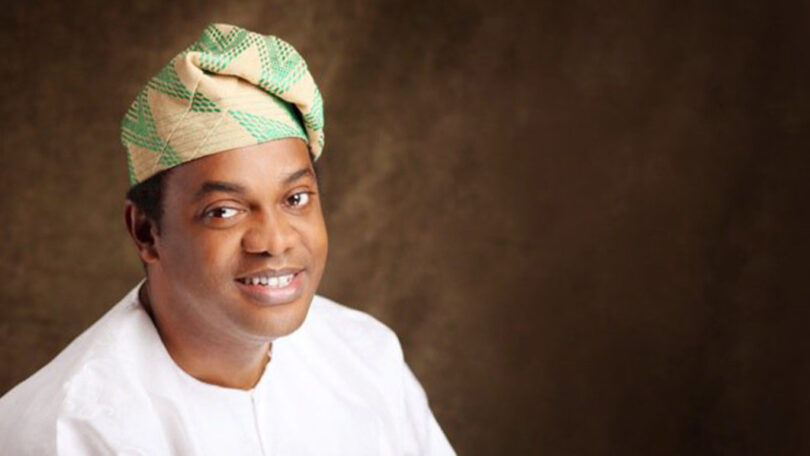
Former Cross River State Governor and presidential candidate of the People’s Redemption Party, PRP, Donald Duke, has described as “a lie” the claim that Nigeria is the wealthiest country in Africa, arguing that the country remains one of the poorest on the continent when measured by per capita income.
Mr Duke also dismissed the description of Nigeria as Africa’s largest economy when it is based solely on the country’s overall Gross Domestic Product, GDP, saying the measure does not reflect the economic reality of ordinary Nigerians.
He made the remarks in an interview with selected journalists in Lagos, where he argued that per capita income provides a better indication of citizens’ economic wellbeing than the size of a country’s GDP.
According to him, several countries that Nigerians regard as smaller economies have higher per capita incomes, stressing that the country was “living a lie” by celebrating its position as Africa’s largest economy.
“It is embarrassing that a country that was considered one of the wealthiest in Africa still thinks today that it is the largest economy in Africa. That is not true.
“We are living a lie. It is a nice sound bite, though, to say that Nigeria is the largest economy in Africa. No. Nigeria is just one of the poorest when you take per capita income into consideration, and that is what you should measure, not just growth.
“If all we were producing in Nigeria was kulikuli, as we have been advised to do, we would still be a large economy in terms of GDP. But individually, what is our capital base? It is very poor.
“Most of these countries that we laugh at have a higher income per capita than we do.
“So, it all comes down to productivity. The idle mind is the playground of the devil. That was true yesterday, it is true today, and it will be true tomorrow,” Mr Duke said.
Security challenges
On the country’s worsening security situation, Mr Duke said he disliked the description of armed groups operating in Nigeria as “Islamic terrorists”, arguing that their activities should not be associated with Islam.
He linked part of the security challenges, particularly in northern Nigeria, to the collapse of Libya, which he said contributed to the movement of arms southwards through Nigeria’s porous land borders.
Mr Duke said the government needed to adopt short-, medium- and long-term measures to tackle insecurity, arguing that kidnapping, banditry and terrorism were symptoms of deeper economic and governance problems.
“Right now, you have got to deal with the security problems as they exist today — kidnapping, banditry, terrorism and all that.
“But even beyond that, those things are consequences of other things. They are consequences of a very poor economy and, of course, the failure to properly manage our borders.
“With the collapse of Libya, a lot of arms have been moving south. We call them Islamic terrorists. I don’t like that phrase because I don’t think they are driven by Islam.
“The Islam I know is different. They just use that connotation to describe them. Rather, I think these are destructive elements. You can see that when they go into communities, they collect taxes and do other things. It is all geared towards collecting or building a resource base for themselves.”
For the medium and long term, Mr Duke said the government should prioritise policies that would increase citizens’ productivity and create opportunities for legitimate economic activity.
He said failure to provide productive opportunities would continue to push people towards alternative means of survival.
The PRP presidential hopeful advocated greater investment in local production and the deployment of modern technology to strengthen border security and curb the movement of arms and other illicit goods.
Duke targets Northern Nigeria’s mineral wealth
On how he would revive the economy of Northern Nigeria if elected president, Mr Duke said his administration would seek to properly structure mining activities and ensure that communities and state governments benefit from the exploitation of mineral resources.
He argued that the region’s mineral deposits, rather than oil exploration in the Chad Basin, represented a significant untapped economic opportunity.
“The rush to produce oil is not synonymous with wealth. You must have commercial quantities and all that. I sometimes think it is overplayed. The oil in the Chad Basin is not available in such commercial quantities.
“I think the real wealth of the North, beyond agriculture, is in the mineral deposits there.
“There must be a structured way of mining. Today, it is artisanal, and the broader community, the border communities, society and the nation itself do not adequately benefit from those resources.”
Using gold mining in Zamfara State as an example, Mr Duke said the state possessed significant mineral resources but had failed to adequately harness them for development.
“Take, for instance, the gold in Zamfara. It probably has — I don’t know — perhaps as much gold as all of Ghana does. Ghana was once called the Gold Coast, so that tells you how much gold there could be in Zamfara.
“But mining has also attracted banditry because Nigeria is largely an unpoliced state,” he said.
He proposed greater economic autonomy for states, saying state governments should be encouraged to identify, evaluate and develop mineral resources within their territories.
“So, I would make each state an economic entity. I think it would encourage states and their governments to focus on the minerals they have.
“If I were in charge, alongside the states, we would carry out an evaluation. I know some of this has already been done. We would evaluate what is available in each state and go further to determine the proven reserves.
“So, for instance, if you are looking for columbite or any other mineral and you know columbite exists in a particular place, let us go further and determine the proven reserves of columbite, lithium or whatever mineral we want to develop.
“Once you have developed it to that level, you make it more attractive for investors to come in. This should be a joint venture between the state and federal governments because the revenues from those resources will be shared by both levels of government.”
Mr Duke, however, stressed that security would remain critical to attracting investment into the mining sector and other productive areas of the economy.
He cited the Niger Delta as an example of how insecurity and rising poverty could drive investors away from resource-rich communities.
“But nobody is going to invest if there is no security. We saw what happened in the South, in the Niger Delta region, when security broke down, which was also a function of increasing poverty in those areas.
“The investors there — the oil companies and international companies — moved out, and they now prefer producing oil from the deep sea, which is considered safer,” he said.