1 / 6
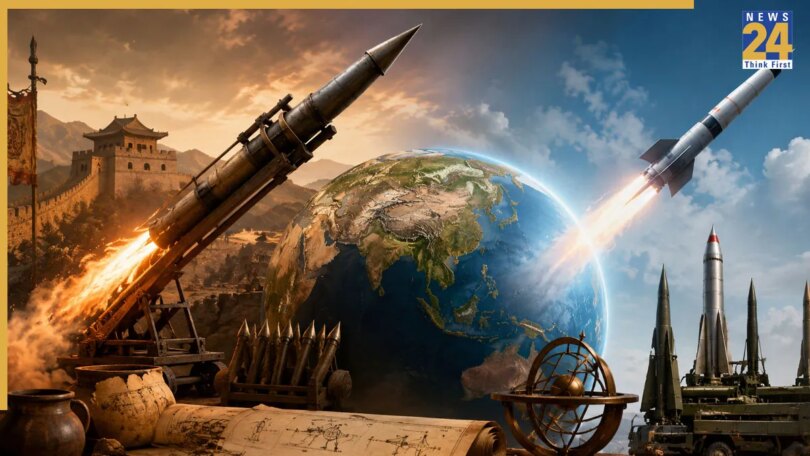
Germany developed the world’s first successful modern ballistic missile, the V-2, during World War II, laying the foundation for today’s advanced missile technology used by major global powers.
Which country built the world’s first modern missile?

2 / 6
Today, countries around the world possess advanced missiles capable of striking targets thousands of kilometres away. Many people assume the United States or Russia pioneered this technology, but history tells a different story. According to historical records, Germany developed the world’s first successful modern ballistic missile during World War II. The V-2 missile is widely regarded as the beginning of the modern missile era and laid the foundation for future missile technology.
What made the V-2 missile revolutionary?

3 / 6
The V-2 was the first long-range guided ballistic missile to be successfully used in warfare. It entered combat in September 1944 and used a rocket engine to climb to a very high altitude before descending at extremely high speed toward its target. At the time, existing air defence systems could not intercept it. Defence experts consider the V-2 one of the most significant technological breakthroughs in military history.
Who developed the V-2 missile?

4 / 6
The V-2 missile programme was led by German rocket scientist Wernher von Braun. After World War II ended, he moved to the United States and became a key figure in the American space programme. Von Braun later played a major role in developing the Saturn V rocket, which powered NASA’s Apollo missions that successfully landed astronauts on the Moon. His work influenced both missile and space technology worldwide.
How did the V-2 change global missile development?

5 / 6
Following Germany’s defeat in 1945, both the United States and the Soviet Union acquired German missile technology and recruited several German scientists. Using knowledge gained from the V-2 programme, both countries rapidly developed more advanced ballistic missiles during the Cold War. In the 1950s and 1960s, they introduced Intercontinental Ballistic Missiles (ICBMs) capable of carrying nuclear warheads over thousands of kilometres, transforming global defence strategies.
Which countries have advanced missiles today?

6 / 6
Today, countries including the United States, Russia, China, India, France, the United Kingdom, North Korea, and Pakistan possess advanced missile systems. These include ballistic, cruise and hypersonic missiles, many capable of travelling thousands of kilometres and carrying conventional or nuclear payloads. According to historical research from NASA, the Smithsonian Institution, and airandspace.si.edu, Germany’s V-2 missile remains the world’s first successful modern ballistic missile and the starting point of today’s missile technology.