
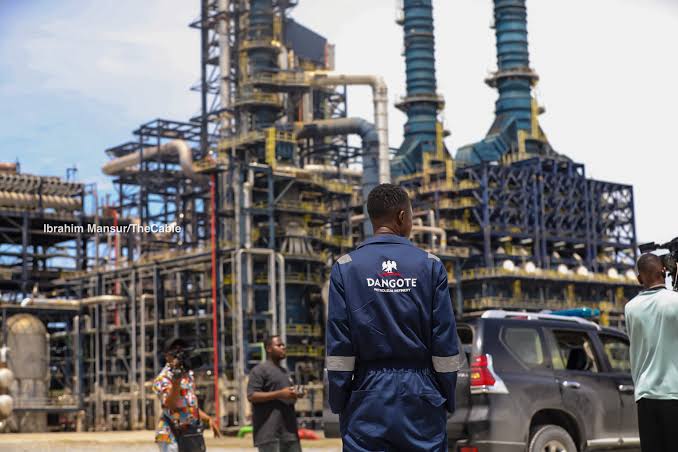
Nigeria has the oil. Nigeria now has one of the world’s biggest refineries. So why does filling your car still feel like a luxury?…
Nigeria has the oil. Nigeria now has one of the world’s biggest refineries. So why does filling your car still feel like a luxury?
That question is understandable — but the answer goes beyond simply having crude oil in the ground or a refinery operating in Lagos.
Nigeria’s petroleum market has changed dramatically with the emergence of the Dangote Refinery, which has reduced the country’s dependence on imported refined products and is now operating above its original 650,000-barrel-per-day design capacity.
But local refining does not automatically mean cheap petrol. Here are the key reasons.
1. Nigeria produces crude oil, not petrol
Crude oil is the raw material. Petrol is a refined product.
It is similar to growing tomatoes: producing the tomatoes does not mean you automatically have tomato stew.
The crude has to be extracted, transported, processed and refined before products such as petrol, diesel, aviation fuel and kerosene can be obtained.
2. Refining crude locally removes one problem — but not every cost
For years, Nigeria exported crude and imported much of its petrol because its state-owned refineries were unable to meet domestic demand.
That meant Nigeria was paying for imported refined products, shipping, insurance, foreign exchange and other associated costs.
The Dangote Refinery has changed that equation by allowing a much larger share of Nigeria’s fuel requirements to be supplied from within the country. The refinery supplied nearly 80 per cent of domestic petrol demand in April 2026, according to an EIU assessment cited by Dangote Industries.
3. Nigerian crude still has a value
This is where the argument becomes less straightforward.
Even if a Nigerian refinery buys Nigerian crude, that crude is not free.
Crude oil is an internationally traded commodity, and its value is influenced by global oil prices.
So a refinery cannot simply treat locally produced crude as having zero cost because it came from Nigeria.
4. Global oil prices can still hit Nigerian petrol prices
The international oil market remains a major factor.
When global crude prices rise, the value of the crude going into refineries rises as well. That can eventually feed into the price of refined products.
The current global market demonstrates the point: Brent crude recently surged above $100 a barrel amid geopolitical tensions and supply concerns.
5. The Dangote Refinery itself does not control the global oil market
The Dangote Refinery can process crude in Nigeria, but it cannot determine the international price of crude.
Indeed, the refinery has recently raised its petrol gantry price from ₦1,265 to ₦1,350 per litre, with the increase coming amid elevated global oil prices.


That means Nigerians can have a locally refined product and still be affected by movements in the international oil market.
6. Refining is a business, not a giveaway
A refinery has enormous costs to recover.
These include the cost of crude, financing, maintenance, electricity and other operational expenses, logistics, storage and distribution.
The refinery also has to remain commercially viable.
So the fact that a product is refined locally does not mean the refinery must sell it below its economic cost.
7. Transporting petrol still costs money
Getting petrol from a refinery to a filling station is another part of the price chain.
Fuel has to be stored, transported and distributed across a country as large as Nigeria.
Those logistics costs eventually form part of what motorists pay at the pump.
8. The price at the refinery is not necessarily the pump price
There is an important difference between the gantry price and the price motorists see at filling stations.
A refinery can sell petrol to a customer at its loading point, but the product still has to move through the distribution chain before reaching consumers.
This explains why pump prices can differ from one location or station to another.
Recent reports, for example, showed filling stations adjusting their prices after the Dangote Refinery’s latest gantry-price increase.
9. Dangote Refinery has made Nigeria more self-sufficient — not immune to price increases
This is perhaps the biggest point.
The refinery is already changing Nigeria’s petroleum landscape.
Its current crude-processing capacity has reached about 700,000 barrels per day, above its original 650,000-bpd design capacity, while plans are in place for further expansion.
It has also helped Nigeria move from heavy dependence on imported refined products towards greater domestic supply and exports.
But self-sufficiency in refining does not mean Nigeria is insulated from global commodity prices.
10. So, will Dangote Refinery eventually make petrol cheaper?
It can help — but it is not a magic switch.
More domestic refining means fewer costs associated with importing finished petrol and less exposure to some foreign-exchange and shipping pressures.
It can also increase competition and supply.
But the final pump price will continue to depend on factors including crude oil prices, refining costs, exchange rates, transportation, distribution and market conditions.
So the better question is not simply, “Why isn’t petrol cheap when Nigeria has crude and Dangote Refinery?”
It is: “How much of the cost of producing, refining and distributing petrol can Nigeria reduce while keeping the entire petroleum value chain commercially sustainable?”
That is where the real price debate begins.