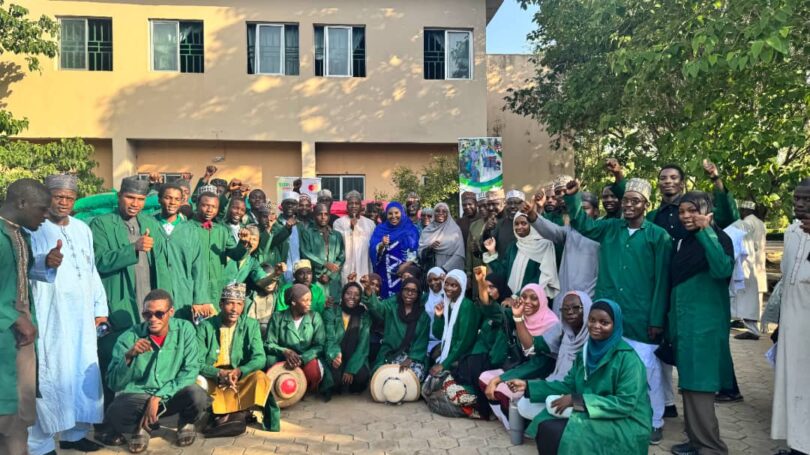
A Nigerian non-profit organisation, the Women Farmers Advancement Network (WOFAN), has provided a N28 million start-up agricultural input grant to support the take-off of the Centre for Dryland Agriculture (CDA) SIBLING Students’ Wet Season Farming Production Unit at Bayero University Kano (BUK), in a move aimed at closing the long-standing gap between classroom learning and practical agricultural experience.
The intervention, which covers 50 hectares of farmland, is designed as a revolving support scheme to ensure sustainability within the university while equipping agriculture students with practical skills in farming, mechanisation, food processing and agribusiness across the entire agricultural value chain.
SolaceBase reports that the initiative is part of the SIBLING Initiative (Skills Improvement to Boost Livelihood and Nurture Growth) -a strategic programme flagged off in February 2026, which was established by Bayero University and WOFAN to strengthen agribusiness training, climate-smart agriculture and livelihood support.
The initiative also promotes innovative student research, encourages specialisation in different agribusiness landscapes and seeks to improve the livelihoods of neighbouring communities, particularly women, micro-enterprises and agro-marketers within and outside the university.
Read Also:WOFAN, CDA launch SIBLING initiative in BUK, distribute 560 bags of rice within the university environs
The two-year pilot programme is expected to train 300 students annually, especially women and junior staff, in practical agro-processing, value addition and agribusiness management as part of WOFAN’s scalability and sustainability strategy under its ICON2 Project.
Speaking during the flag-off ceremony in Kano on Thursday, the WOFAN Group Executive Board Chair, Dr Salamatu Garba, said the organisation introduced the initiative to address one of the major challenges facing higher education, where many graduates leave university with strong theoretical knowledge but limited practical experience.
She said the programme would expose agricultural students to integrate agricultural production by combining experienced extension service providers needed to bridge the shortfall of extension workers in the agricultural work space, which will ultimately boost farmers’ crop cultivation capabilities, processing, entrepreneurship and value chain development, ensuring that every stage of production adds value while minimising waste.
According to her, the initiative embraces a “zero waste” approach through backward integration across the agricultural value chain, enabling students to acquire hands-on skills that would prepare them for self-employment and agribusiness after graduation.
Read Also:BUK appoints WOFAN founder Salamatu Garba as Chair, CDA Advisory Board
She added that while Bayero University allocated 25 hectares for practical farming, WOFAN financed the required agricultural inputs before extending support to another 25 hectares, bringing the total intervention to 50 hectares valued at N28 million, so that research will effectively be transformed to sustainable livelihood improvement.

“The inputs are being provided as a revolving scheme. WOFAN has donated them to the university as a grant so the agricultural students from their 4th and 5th year in the university will design an input repayment system to revolve and sustain the initiative. It will also boost an open market for access to farm input and promote the from-farm-to-table initiative of enhancing food security in Nigeria. Dr
In his remarks, the Vice-Chancellor of Bayero University Kano, Professor Haruna Musa, described the initiative as a strategic intervention that would significantly improve practical agricultural education, enhance climate-smart farming and contribute to national food security.
According to him, no country can achieve sustainable development without guaranteeing food security, noting that agriculture remains central to achieving the Sustainable Development Goals, including poverty reduction, zero hunger, improved health and economic growth.
He urged students to take full advantage of the opportunity by combining classroom knowledge with practical experience.
“With hard work, perseverance, dedication and sincerity of purpose, the sky will be your limit,” he said.
Professor Musa also assured WOFAN that the university would sustain the initiative and announced a N1 million contribution from the university management to support the project.
Read Also:WOFAN partners BUK to train students, empower women in agribusiness skills

Earlier, the Director of the Centre for Dryland Agriculture, Professor Sanusi Gaya, described the launch of the crop production component as another milestone following the inauguration of the SIBLING Initiative in February 2026.
He said students participating in the programme had made the right decision by embracing practical agriculture and pledged the Centre’s full support to ensure the initiative’s success and sustainability.
The Dean of the Faculty of Agriculture, Professor Aminu Sulaiman, said the programme would produce graduates with practical agricultural and entrepreneurial skills capable of becoming employers of labour instead of job seekers.
He disclosed that the faculty had developed a SIBLING Sustainable Business Management Model, built around a revolving fund and strategic partnerships, to ensure the project’s long-term sustainability.
Also speaking, the Chairman of the WOFAN Board, Professor Sani Miko, described the initiative as a unique platform that would equip students with practical agricultural skills alongside their academic training.