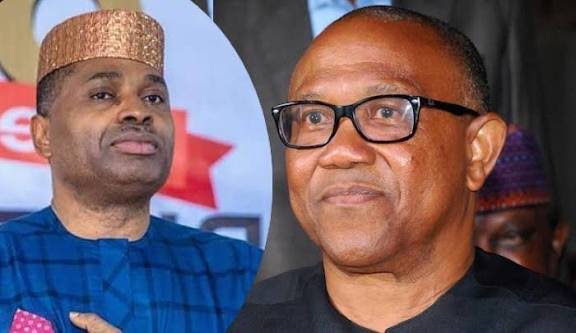
Former Labour Party presidential campaign spokesman, Kenneth Okonkwo, says Peter Obi has changed significantly since the 2023 presidential election, insisting that his decision to part ways with the former Anambra State governor was based on changing political circumstances….
Former Labour Party presidential campaign spokesman, Kenneth Okonkwo, says Peter Obi has changed significantly since the 2023 presidential election, insisting that his decision to part ways with the former Anambra State governor was based on changing political circumstances.
Okonkwo, now a chieftain of the African Democratic Congress (ADC), said he campaigned for Obi in 2023 because he was the Labour Party’s presidential candidate at the time, but never entered an agreement to follow him regardless of subsequent political decisions.
“I campaigned for him as a member of Labour Party and as the presidential candidate of Labour Party. There was no agreement I should follow him wherever he’s going to because if he’s going to fall into a pit, I do not have any contract to fall into the pit with him,” Okonkwo said.
He added that the politician he supported in 2023 was, in his view, different from the person he now sees, citing changes in political platforms and information surrounding the former governor.
“So what the person you’re seeing now is completely different from the person I campaigned for, different platform from the information that I have heard, different human being,” he said.
Okonkwo’s comments come amid continuing divisions among opposition politicians ahead of the 2027 presidential election. Obi and former Kano State governor Rabiu Kwankwaso left the ADC coalition for the Nigeria Democratic Congress (NDC), while the ADC has continued to advocate a common opposition platform.
On the question of whether opposition parties can still produce a single candidate, Okonkwo said the legal window for replacing presidential candidates was now limited.
According to him, once candidates have emerged through primaries, a candidate can only be replaced where the candidate voluntarily withdraws or dies, subject to the applicable electoral process.
He argued that this leaves opposition parties with the option of an alliance or coalition arrangement rather than simply altering the outcome of completed primaries.
Okonkwo maintained that the ADC had previously opened its presidential primary to opposition aspirants rather than reserving its ticket for a particular politician.
He said the party’s primary was contested by three major aspirants and that no candidate was prevented from participating.
The ADC chieftain also argued that opposition politicians who could not secure their preferred outcome through a primary would face an even greater challenge confronting an incumbent president in a general election.
He cited the division of opposition votes in the 2023 presidential election, when Bola Tinubu, Atiku Abubakar and Obi emerged as the three leading candidates, with Rabiu Kwankwaso also attracting a significant share of the vote.
INEC’s final figures put Tinubu at about 8.8 million votes, Atiku at about 6.98 million and Obi at about 6.1 million.
Okonkwo said the figures demonstrate the argument for opposition consolidation, although the votes of separate candidates cannot automatically be assumed to transfer to a single candidate in another election.
He also criticised Obi and other opposition figures who left the ADC coalition for the NDC, questioning their decision to pursue separate political arrangements.
Okonkwo has repeatedly argued that opposition parties need to unite behind a single platform to mount a stronger challenge to the APC in 2027.
His latest comments continue his criticism of Obi after the political alliance between the two men during the 2023 election.