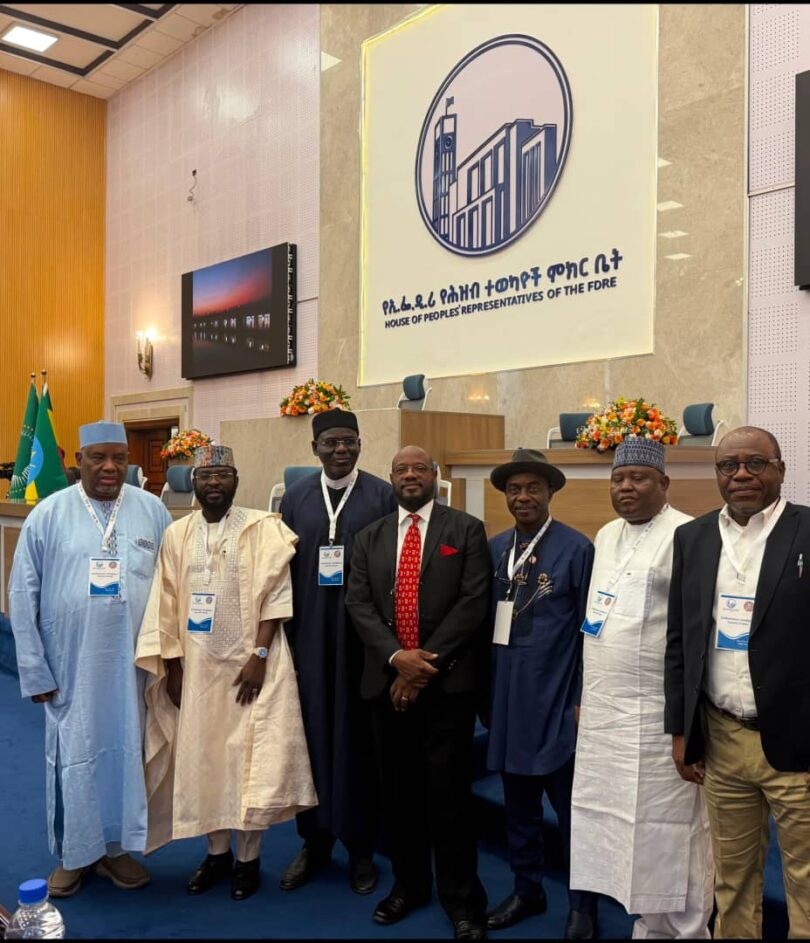
Africa faces an unprecedented convergence of existential security threats that demand unified, African-led responses, retired Lieutenant General TY Buratai warned today at the 32nd Parliamentary Intelligence-Security Forum.
Delivering the keynote presentation “Africa’s Priority Security Threats,” the former Nigerian Chief of Army Staff (2015–2021) outlined five critical threats: terrorism and violent extremism, transnational organised crime, cybersecurity vulnerabilities, governance and social unrest, and sovereignty erosion through external dependency.
THE SAHEL: GLOBAL EPICENTRE OF TERRORISM
The Sahel now accounts for nearly half of global terror-related deaths. Between January and November 2025 alone, West Africa recorded 450 attacks and over 1,900 fatalities.
Burkina Faso presents a complex picture. Under President Ibrahim Traoré, the armed forces have made significant territorial gains, claiming a reconquest rate of 72.70 per cent by June 2025. Operation Lalmassga enabled forces to regain control of dozens of localities. In early 2026, intensified operations killed at least 400 militants. However, deadly jihadist attacks have continued. In February, JNIM launched a deadly offensive killing dozens. In early July, suspected extremist attacks killed at least 22 soldiers and militia members near Dédougou.
The departure of Burkina Faso, Mali, and Niger from ECOWAS in January 2025 has crippled regional intelligence sharing. Coastal West African states are increasingly entangled in Sahelian extremism—attacks in northern Benin, which grew from 22 in 2021 to 176 in 2024, with deaths doubling between 2022 and 2024.
TRANSNATIONAL ORGANISED CRIME & CYBERSECURITY
West Africa faces “unprecedented interlocking threats” blurring the lines between terrorism financing, piracy, and cyber fraud. The Gulf of Guinea accounted for 87 per cent of all crew kidnappings globally in the first half of 2025, with piracy incidents rising 25 per cent.
Cyber threats are escalating exponentially. Kenya recorded 840 million cyber threat events in Q4 2024, surging 201.7 per cent to 2.54 billion by Q1 2025—nearly five attacks per citizen in three months. Terrorist groups are increasingly using AI, cryptocurrencies, and deepfakes against African states.
GOVERNANCE, SOVEREIGNTY & DEPENDENCY
Civil unrest is rising across the continent. 2025 saw two military coups and one failed attempt, bringing the total to eight African countries now run by the military. Financial exclusion, weak institutions, and failing public services are exploited by armed groups.
Outsourcing security to external actors carries high costs to sovereignty and long-term peace. African governments are pushing for data sovereignty and reducing dependence on foreign suppliers. Geopolitical pressure from US-China competition places African nations under significant stress.
CALL TO ACTION: PARTNERSHIP AND DONATIONS
“The threats confronting Africa are no longer isolated national challenges but shared regional crises,” General Buratai declared. The principle of “African solutions to African problems” must shift from slogan to reality.
General Buratai issued an urgent appeal to the international parliamentary community: while African nations are determined to take ownership of their security, they lack the resources to match their ambition. He called on partner nations, international organisations, and foundations to contribute to a dedicated African Security Capacity Fund. Such contributions would accelerate the operationalisation of the African Standby Force, strengthen AFRIPOL’s intelligence-sharing mechanisms, and support community-based counter-extremism programmes.
“The cost of inaction is far greater than the cost of investment,” Buratai said. “Every dollar donated to African-led security is a dollar saved from the human and economic devastation of unchecked terrorism. We ask not for charity but for partnership—partnership that respects African agency while empowering African institutions to protect African lives.”
Lt Gen TY Buratai (Rtd) CFR served as Nigeria’s Chief of Army Staff (2015–2021), was a member of the African Union Experts on the African Standby Force (2005–2007), served as force commander of the Multinational Joint Task Force in Ndjamena, Chad, and was Nigeria’s Ambassador to Benin (2021–2023).