
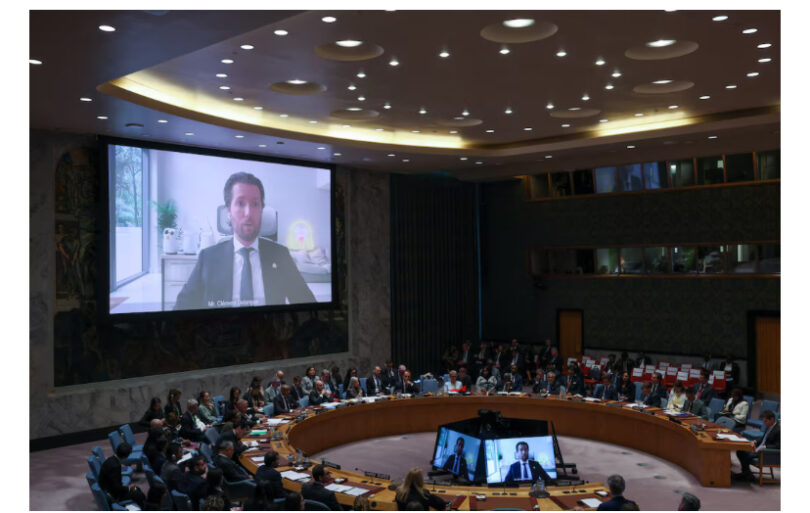
Leading artificial intelligence executives have urged world governments to establish international safeguards for increasingly powerful AI systems, warning that poorly managed technology could pose serious risks to humanity.
OpenAI chief executive Sam Altman and Anthropic CEO Dario Amodei were among technology leaders who addressed the United Nations Security Council on Wednesday during a high-level meeting on artificial intelligence and international security. The meeting was convened by France during the 81st session of the UN General Assembly.
“If managed poorly, I even believe AI could be a risk to humanity as a whole,” Amodei told the 15-member council. Altman also warned about the possibility of humans losing control over increasingly capable systems, saying: “We could lose control of the future to AI.” Both executives called for greater international cooperation to manage the technology, while stressing that AI could also deliver major benefits if developed safely and used to empower individuals.
Altman argued that decisions about the future of AI should not remain solely in the hands of technology companies. “If AI is to be democratic, the most important decisions cannot be made by labs in San Francisco alone,” he said. “They must be shaped through democratic processes and by governments accountable to the people that they serve.”
Amodei called for international agreements aimed at preventing AI from being used to develop biological weapons, alongside common standards for testing advanced models and systems for determining what those models are capable of doing. He also urged governments to establish mechanisms for addressing the risk of humans losing control of advanced AI and the possibility of the technology being misused.
Hugging Face chief executive Clément Delangue also addressed the council remotely as governments considered how international rules could be developed without concentrating control of AI in a single company or country. British Foreign Secretary Ed Miliband said warnings from the executives demonstrated that governments could not leave responsibility for preventing potentially catastrophic outcomes solely to technology companies.
Miliband said Britain would put AI governance at the centre of discussions when it leads the G20 next year, including efforts to establish common global standards for safe development. The United States, however, opposed creating a new global governance structure that could restrict development.
White House Science Adviser Michael Kratsios said concerns about losing control of AI were “not a reason to pause its further development or to constrain it with new global governance structure,” adding that Washington wanted its allies and partners to share in the technology’s benefits. China also stressed that countries should retain the ability to choose how they develop and use artificial intelligence. Chinese UN Ambassador Fu Cong warned against creating rival technological blocs and advocated broader access to open-source AI models.
French Foreign Minister Jean-Noël Barrot, whose country convened the Security Council meeting, compared the emergence of advanced AI with the beginning of the atomic age, arguing that international cooperation was necessary to capture its benefits while limiting its dangers. Concerns over autonomous weapons also featured prominently in the wider UN discussions.
Ukrainian President Volodymyr Zelenskyy warned during the General Assembly that AI could increasingly make battlefield decisions that were previously reserved for humans, arguing that meaningful human control over such systems needed to be maintained.
The debate comes amid growing disagreement over how aggressively governments should regulate AI. While some technology executives and governments are seeking common safety standards and international coordination, others warn that excessive restrictions could hinder innovation and affect the technological competition between major powers.
Despite those differences, the AI executives told the Security Council that increasingly capable systems would require greater cooperation among governments, technology companies and international institutions to ensure humans remain in control of critical decisions.