
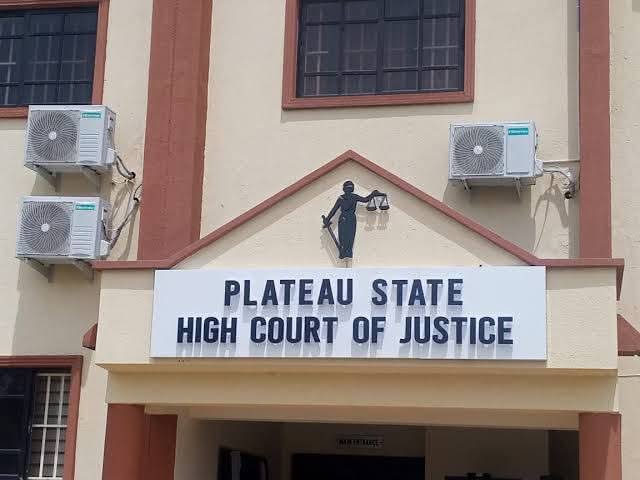
A High Court in Plateau State has ruled that state High Courts have jurisdiction to try persons accused of terrorism and related offences under the Terrorism (Prevention and Prohibition) Act (TPPA) 2022….
A High Court in Plateau State has ruled that state High Courts have jurisdiction to try persons accused of terrorism and related offences under the Terrorism (Prevention and Prohibition) Act (TPPA) 2022.
The ruling was delivered on Tuesday by Justice Gedeliah Fwomyon while determining a jurisdictional objection raised by four suspects accused of participating in the Easter 2026 Angwa Rukuba massacre in Plateau State.
The decision could have significant implications for the prosecution of terrorism cases in Nigeria, particularly over the jurisdiction of state courts to handle offences under the federal terrorism law.
The four suspects — Isa Umar Ibrahim, Adamu Isa Alhassan, Auwalu Abubakar, also known as Auwalu Dogo, and Musa Abubakar Ibrahim, also known as Yaroro — were arrested by the Department of State Services (DSS) following the killings.
The Plateau State Government subsequently filed terrorism charges against them.
During the proceedings, defence lawyers challenged the jurisdiction of the state High Court, arguing that terrorism cases under the TPPA fell outside its jurisdiction and could only be handled by a Federal High Court.
Justice Fwomyon rejected the argument, holding that although the TPPA is federal legislation, it does not expressly prohibit a State High Court from prosecuting offences contained in the Act.
The judge also held that there was nothing in the Constitution preventing State Houses of Assembly from legislating on terrorism, stressing that terrorism is not an item on the Exclusive Legislative List.
The court further ruled that the Plateau State Penal Code was not inconsistent with the TPPA and that both the National Assembly and State Houses of Assembly could validly legislate on terrorism.
The court also dismissed an application by the third defendant, Auwalu Abubakar, seeking his transfer from DSS custody to the Jos University Teaching Hospital (JUTH) for medical attention.
Justice Fwomyon noted that medical examinations had been conducted following the suspects’ arrest and that the results indicated that they were medically fit for detention.
The judge also held that the court could not grant relief based on documents that had not been presented before it.
According to the court, the applicant failed to provide the medical report on which his request for transfer was based.
“Motion of the defendant is hereby refused and dismissed for failure to establish sufficient factual foundation upon which the relief is sought,” the judge ruled.
The court subsequently adjourned the matter to 15 and 21 October 2026 for further proceedings.