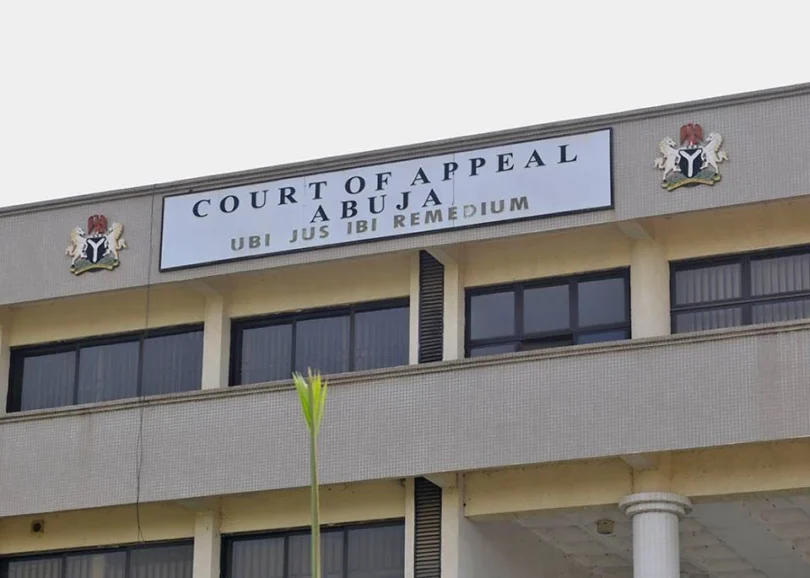
The Court of Appeal in Abuja has set aside a Federal Capital Territory High Court judgment that held Fidelity Bank Plc liable in a fundamental rights suit arising from the arrest and detention of Michael Kundera.
A three-member panel led by Justice Adebukola Banjoko delivered the judgment on September 14, 2026, allowing the bank’s appeal and overturning the lower court’s decision.
The FCT High Court, presided over by Justice Peter Kekemeke, had previously held that Kundera’s fundamental rights were violated and awarded N10 million in costs against Fidelity Bank, the Economic and Financial Crimes Commission and former EFCC Chairman, Abdulrasheed Bawa.
Kundera’s case stemmed from his arrest and detention between May 15 and 16, 2023. He had challenged the circumstances of his detention, arguing that he was neither charged before a court nor granted bail.
He also connected the dispute to a parcel of land at the Foreign Affairs Quarters, which he claimed belonged to him.
Fidelity Bank, dissatisfied with the High Court decision, appealed the judgment, arguing that the evidence before the court did not establish any connection between the bank and an infringement of Kundera’s constitutional rights.
The bank maintained that its involvement arose from a petition it submitted to the EFCC over alleged criminal conduct involving entities that had secured a N100 million loan procurement order from the bank for a particular project.
According to the bank, the funds were allegedly diverted for personal purposes, but Kundera was not the subject of its petition.
It therefore argued that the lower court had no sufficient basis to impose liability on the bank for the alleged violation of Kundera’s rights.
In its judgment, the Court of Appeal agreed with the bank, holding that there was no credible evidence establishing that Fidelity Bank had infringed Kundera’s fundamental rights.
The appellate panel further held that Kundera failed to discharge the burden of proof required to sustain the claims against the bank and justify the reliefs granted by the trial court.
The decision consequently reversed the finding of liability against Fidelity Bank in the case.