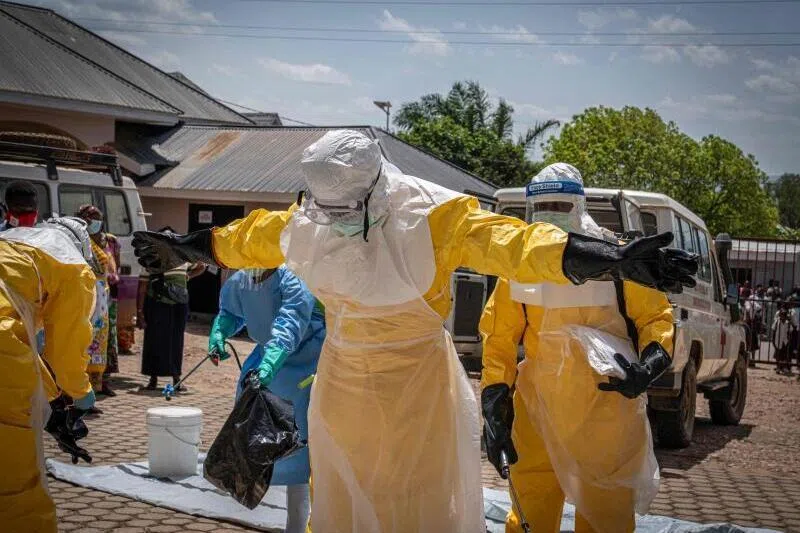
The Ebola crisis in eastern Democratic Republic of Congo has drawn about US$500 million (S$640 million) in global pledges as African leaders and international health officials warned the outbreak risks spreading across the continent.
The commitments, announced during a briefing of state officials on May 25, have more than doubled from the almost US$208 million secured as of May 23, according to Africa Centres for Disease Control and Prevention Director-General Jean Kaseya.
Major contributions included US$160 million from the World Bank for Congo, US$82 million from the US and about US$57 million from European partners.
Dr Kaseya said the commitments had nearly closed the gap to the estimated US$519 million needed for the response, though he warned the funding requirement was likely to rise as the outbreak spreads and preparedness efforts expand.
As Ebola spreads through conflict-hit eastern Congo, South African President Cyril Ramaphosa warned the outbreak had become a serious threat to the continent, citing the risk of wider regional spread driven by insecurity, cross-border movement and fragile health systems.
“Health security is economic security,” Mr Ramaphosa said May 25 at the virtual briefing. “It’s also development security and the security of our entire continent.”
Mr Ramaphosa – also the African Union champion on pandemic prevention, preparedness and response – said the outbreak was unfolding in areas marked by “intense population movement, insecurity, porous borders, humanitarian pressure and active trade corridors,” making rapid containment more difficult and increasing the urgency of a coordinated African response.
“We have already lost more than 200 people,” he said, calling for “speed, unity, solidarity and trust in our collective capacity.”
More than 900 suspected Ebola cases have been reported across 11 health zones in three eastern Congolese provinces, according to health ministry data released late on May 24. Regional figures show suspected deaths reached 210 as of May 23. Uganda reported two new cases on May 25, both health workers.
Ten African countries – including Kenya and Angola – are now considered at high risk for their own outbreaks because of known travel routes and porous border crossings, according to Dr Kaseya. All other nations on the continent are at risk of importing cases because of regional mobility and gaps in surveillance and diagnostic capacity, he added.
“The delay in detecting the outbreak means that we are now playing catch up with a very fast-moving epidemic,” World Health Organization Director-General Tedros Adhanom Ghebreyesus said at the briefing. “We have stopped every previous Ebola outbreak and we will stop this one too. The question is just how quickly we can do it and how many more lives will be lost before we do.”
As many as one in three people in Ituri believe the virus isn’t real, according to ActionAid, a charity group that started conducting information sessions to address misinformation.
“We are not just fighting a deadly virus, we are fighting myths, fear and deep-seated suspicion,” Dr Saani Yakubu, the director of ActionAid DRC, said in a statement.
The crisis is being driven by the rare Bundibugyo strain of Ebola, for which there are no approved vaccines or antibody treatments. The WHO declared the epidemic a public-health emergency of international concern on May 17. BLOOMBERG