
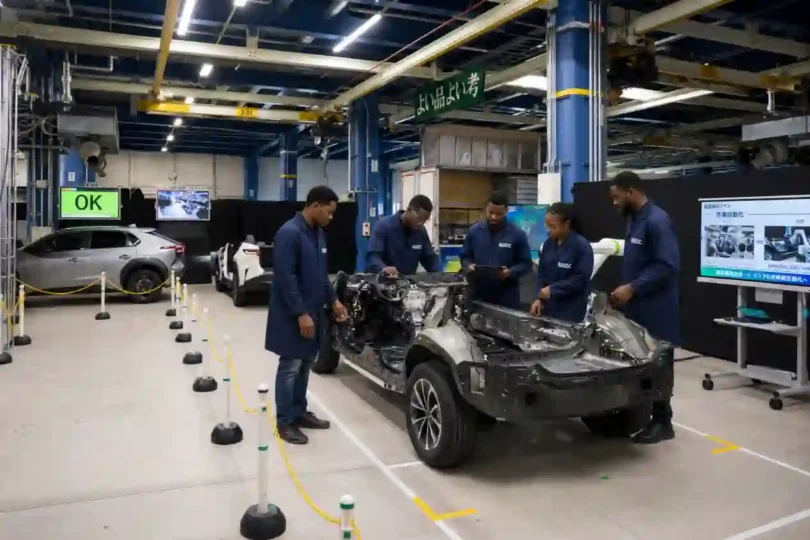
The Federal Government, through the National Automotive Design and Development Council (NADDC), has launched a specialised Electric Vehicle (EV) training programme for Nigerian university students as part of efforts to develop local capacity in electric mobility and prepare young engineers for the future of transportation.
The training, currently taking place at the Toyota Nigeria Training Centre in Lagos, is focused on equipping students with practical knowledge in EV technology, vehicle assembly, battery systems, manufacturing processes, and electric vehicle design.
The initiative is also aimed at supporting Nigeria’s growing interest in clean energy transport and strengthening the country’s ability to produce electric vehicles locally instead of depending entirely on foreign expertise.
Speaking during the programme, a facilitator and NADDC official, Engr. Simon Vandu Dzuwagu, said the council introduced the training to close the gap between theoretical learning in classrooms and real industrial experience.
According to him, many engineering students graduate with strong academic knowledge but limited exposure to practical automotive systems, especially in emerging technologies like electric vehicles.
“The purpose of this programme is to bridge the gap between academic learning and industry practice. The council wants students to gain practical knowledge so that after graduation, EV technology will not be new to them,” Dzuwagu said.
He explained that the training programme runs for 14 days and has been divided into two batches of 15 students each. He added that there are plans to expand the programme to accommodate about 45 participants.
Dzuwagu said participants are receiving hands-on training in vehicle production systems, battery management technology, project management, EV design processes, and automotive manufacturing operations.
He noted that students are also being exposed to battery performance improvement techniques that can suit Nigeria’s environment and operational conditions.
According to him, one of the major goals of the programme is to help students move from design concepts to actual vehicle production.
“At the end of the programme, the goal is to produce a functional electric vehicle based on the design developed by the University of Benin during the EV competition,” he stated.
Some of the students participating in the training described the programme as an important opportunity to improve their understanding of electric mobility and practical engineering systems.
A Mechanical Engineering student of the Federal University of Technology, Owerri (FUTO), Chikamso Chidiakoma, said the training is helping participants address technical gaps they experienced while working on previous EV projects.
Chidiakoma was part of a team that emerged among the top three during the NADDC Electric Bus Competition held last year.
According to him, the current programme is giving students deeper insight into electric vehicle systems and industrial production standards.
“We are learning the basics of production, safety, components and design, manufacturing, and electric vehicles,” he said.
He explained that although students had carried out independent research during previous competitions, practical exposure remained a major challenge.
“There were some challenges we faced while working on the EV project. We tried to learn as much as possible about electric vehicles, but we still had some knowledge gaps. I hope this training will help bridge those gaps,” he added.
He further stated that the programme is improving their understanding of battery range, power systems, EV implementation processes, and vehicle design structures.
Another participant, Leonard Oseghale, a 400-level Mechatronics Engineering student of the University of Benin, said the training represents the second phase of the institution’s electric bus development project.
“We were invited for an Electric Vehicle training programme as the second phase of assembling an EV bus for our campus,” he said.
Oseghale explained that the programme aligns with his long-term ambition of building an electric vehicle company in the future.
According to him, students are learning about manufacturing cycles, production planning, workforce coordination, assembly systems, and project execution timelines.
He also revealed that the University of Benin team adopted a unique biomimicry approach during the design stage of their EV project.
“Our design at the University of Benin is unique because we adopted biomimicry technology. Our reference was the boxfish, which naturally has a shape that reduces air resistance,” he explained.
“Instead of following the traditional bus design, we chose a design inspired by nature to improve aerodynamics.”
He added that the electric bus project would be completed in phases, beginning with training and design before moving into full assembly operations.
Also speaking, a technical instructor at the Toyota Nigeria Training Centre, Mr. Saheed Soriola, said Toyota partnered with NADDC to provide students with industrial exposure and practical engineering experience in EV technology.
“This programme was organised by NADDC for university students to expose them to industrial experience in electric vehicle technology,” Soriola said.
“Toyota Nigeria is supporting the students by broadening their practical knowledge and experience in electric vehicle engineering.”
He noted that Toyota has remained active in electric mobility development globally, especially through its hybrid vehicle technologies and alternative energy transportation systems.
The programme comes at a time when global demand for cleaner transportation systems continues to rise, with many countries investing heavily in electric vehicle production, battery innovation, and sustainable mobility solutions.
What do you think about this?
Drop your opinion in the comment section.
FOLLOW US & Share this with someone who needs to see this.