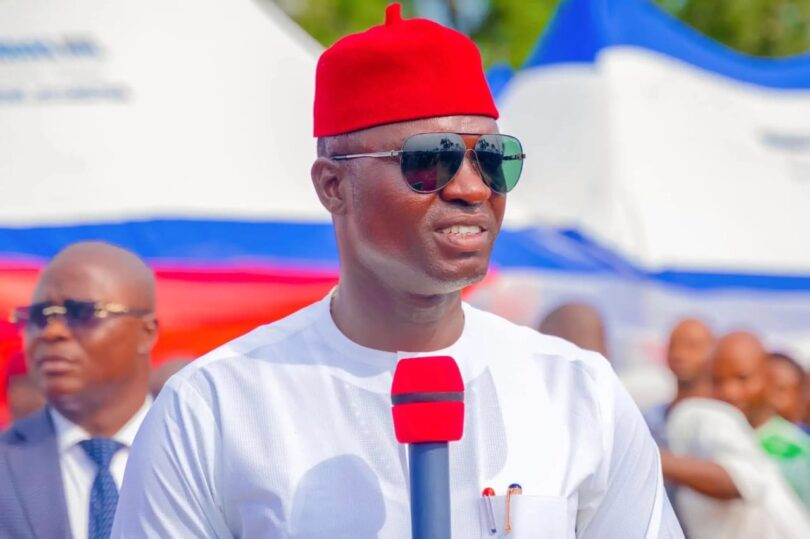
For many observers, this focus on rural development reflects Nwifuru’s conviction that governance should begin with those closest to the grassroots. Development, in his view, should not be concentrated only in urban centres but should reach communities where the majority of citizens live and work.
Beyond physical infrastructure, Governor Nwifuru has sought to strengthen traditional institutions and promote peace. His administration has intervened in longstanding communal disputes, supported reconciliation initiatives, and worked with traditional rulers to preserve harmony across communities. Government officials have also highlighted efforts to resolve disputes over traditional stools and rebuild damaged community assets where necessary.
Perhaps the most distinctive feature of Governor Nwifuru’s administration has been his approach to politics. Rather than allowing political competition to create permanent divisions, he has consistently projected an inclusive style of leadership.
Supporters credit him with bringing together former governors, experienced politicians, and leaders from different political tendencies in pursuit of a common vision for Ebonyi’s development. Through regular consultations with political leaders, traditional rulers, religious organizations, and community stakeholders, he has encouraged dialogue over confrontation and consensus over conflict.
Appointments into government have reflected an effort to accommodate different senatorial zones, local government areas, and political interests. While no administration can satisfy every expectation, this inclusive approach has contributed to an atmosphere many supporters describe as more politically stable than in previous periods.
Within the ruling party, Nwifuru has also emphasized internal cohesion. His leadership style has generally avoided winner-takes-all politics, preferring consultation and collective responsibility. This has enabled experienced political actors to remain engaged in governance rather than becoming isolated after electoral contests.
Observers also note that Governor Nwifuru has publicly maintained that political parties should be allowed to determine their candidates through their established processes. Such comments have been interpreted as support for internal party democracy and the emergence of candidates who command broad grassroots acceptance.
Another defining characteristic of his administration is its investment in human capital. Scholarships, youth empowerment, agricultural support programmes, business grants, and vocational training initiatives are intended to expand opportunities beyond government employment. By equipping citizens with education, skills, and access to finance, the administration hopes to build a stronger and more diversified state economy.
Agriculture continues to occupy a central place in the government’s development strategy. Programmes supporting farmers, agricultural processing, and food production are designed not only to strengthen food security but also to generate employment and increase rural incomes.
Security has similarly remained an important priority. Investments in logistics for security agencies, alongside engagement with community leaders, have sought to create a more secure environment for businesses and residents.
Governor Nwifuru has often emphasized his confidence in the state through personal example. His public remarks expressing a preference to reside in Abakaliki as Governor have been interpreted by supporters as a reflection of his belief in the security and livability of Ebonyi State.
Leadership, however, is measured not only by projects completed but also by the ability to develop future leaders. One enduring question in Nigerian politics is whether those who attain high office create opportunities for others to grow. The true legacy of leadership is often found in the number of capable men and women mentored, empowered, and entrusted with responsibility.
Supporters argue that Nwifuru’s administration has consciously sought to broaden participation in governance by giving younger leaders, professionals, and grassroots politicians opportunities to contribute to public service. Whether this ultimately produces a new generation of national leaders will be judged by history.
Like every administration, Governor Nwifuru’s government is not without its critics. Questions have been raised in some quarters about public spending, borrowing, transparency, and the pace of implementation of certain programmes. Such debates are a normal feature of democratic governance and underscore the importance of accountability and independent evaluation.
Nevertheless, there is broad agreement that Governor Nwifuru has placed considerable emphasis on inclusive governance, infrastructure development, education, workers’ welfare, youth empowerment, agriculture, and peace-building. His administration’s People’s Charter of Needs has become the guiding philosophy through which these priorities are pursued.
From Mr. Speaker to Mr. Governor, Francis Ogbonna Nwifuru’s journey reflects the story of a homegrown politician whose leadership has been shaped by grassroots experience and legislative service. Whether history ultimately remembers him as one of Ebonyi’s transformational leaders will depend on the enduring impact of his policies and institutions. For now, supporters contend that he has demonstrated how politics, when guided by inclusion, humility, and a commitment to development, can become a powerful instrument for uniting people and advancing the common good.
Dozie Ikedife Jr
Nnewi