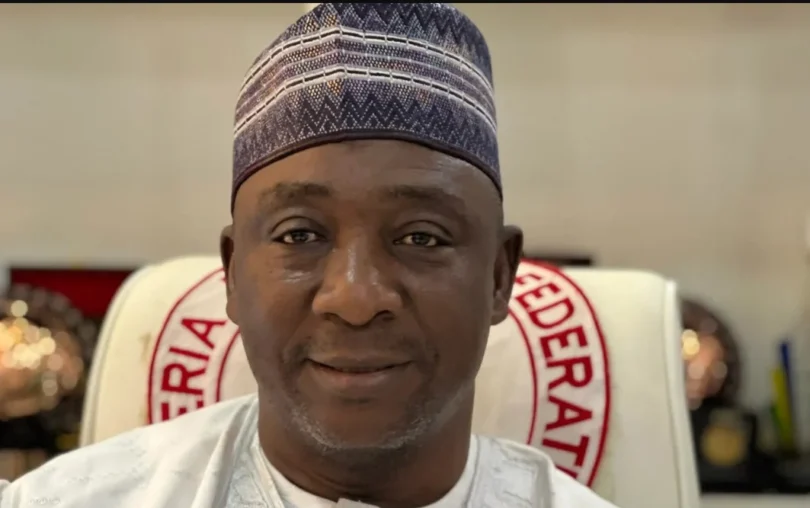
Ibrahim Gusau has confirmed his resignation as President of the Nigeria Football Federation, saying he stepped down after consultations with his family and close associates and out of his desire to continue contributing to the development of Nigerian football.
Gusau announced his decision on Thursday at a press conference in Abuja, bringing to an end his three years and 11 months at the helm of the country’s football governing body.
His resignation came amid mounting concerns over the performance of Nigeria’s national teams and growing speculation about the future of the NFF leadership.
Explaining his decision, Gusau said his love for the country and commitment to the growth of the sport informed his decision to relinquish the position.
“I have decided to resign my position as the President of NFF, after consultations with my family and friends,” he said.
He added that he had encouraged members of the NFF Executive Committee who were willing to follow his example to also resign.
“I have also advised my board members, those who are willing, to resign as well,” Gusau said.
The former NFF president, however, said he could not immediately provide details of the board members who had stepped down, explaining that some had yet to formally communicate their decisions to him.
Gusau’s departure comes at a difficult period for Nigerian football, with the country’s national teams struggling to maintain their traditional dominance on the international stage.
The Super Eagles failed to qualify for the 2022 and 2026 FIFA World Cups, while the Super Falcons recently suffered the unprecedented setback of missing qualification for the 2027 FIFA Women’s World Cup.
Nigeria’s poor run has also extended to the youth teams, with the Golden Eaglets missing out on qualification for three consecutive editions of the FIFA U-17 World Cup.
Despite the challenges, Gusau defended aspects of his administration, pointing to initiatives in coaching education, league development, refereeing and football infrastructure.
He said the federation expanded opportunities for coaches by organising CAF B and C Licence programmes as well as courses for coaching instructors. The CAF A Licence programme, he added, was scheduled to begin on September 16.
According to him, the administration also inherited significant challenges in the management of Nigeria’s domestic leagues but made efforts to stabilise the competitions and improve their organisation.
Gusau also highlighted developments in Nigerian refereeing, saying the federation had worked to address the country’s declining representation at major international competitions.
He said the NFF deliberately introduced younger referees into the system and provided them with opportunities for training and exposure.
“Today, we are beginning to see the results,” he said, citing the participation of Nigerian referees at the FIFA U-17 World Cup and the Women’s Africa Cup of Nations in Morocco.
He noted that some Nigerian officials were selected to handle matches at the competitions, including semi-final fixtures.
Gusau expressed confidence that continued investment in referee development would help restore Nigeria’s presence at major international tournaments.
On infrastructure, he described the shortage of quality facilities as one of the biggest obstacles facing Nigerian football.
He said the NFF used funds available through FIFA development programmes to begin addressing the problem, with particular attention to facilities for the national teams.
“As a board, we sat down and identified infrastructure as one of our greatest needs,” he said.
“We also recognised the need for permanent accommodation and training facilities for our national teams, and we are currently working on that.”
Gusau said the infrastructure initiatives would remain part of the legacy of his administration, adding that he believed Nigerians would eventually recognise the efforts made to address the long-standing problem.
Despite leaving office, Gusau said he would remain available to contribute to Nigerian football whenever his experience and connections were needed.