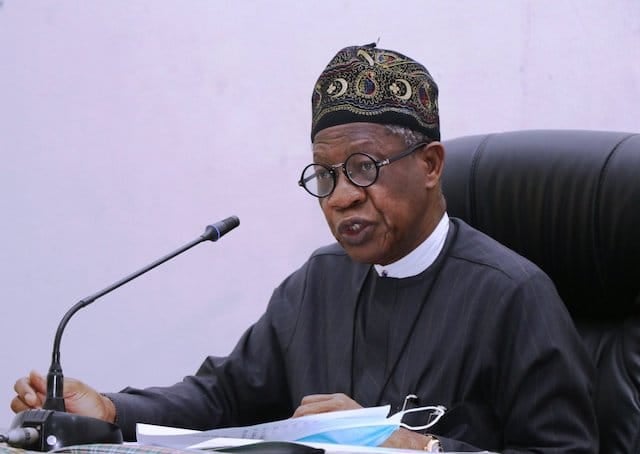
Former Minister of Information and Culture, Lai Mohammed, has disclosed how the opposition was able to successfully challenge the ruling party in 2015.
During his address at Abbey College, Cambridge, UK, on Wednesday, Mohammed traced the origins of this transformation back to the aftermath of Nigeria’s 2003 general elections, which he notably referred to as a “political tsunami.”
He disclosed that discipline and strategic communication unified the divided opposition into a cohesive national movement.
He said, “2003 was a year marked by a political tsunami in Nigeria, a year when the opposition faced what could be considered its most significant setback in the nation’s political history.
“When Nigeria transitioned back to democratic governance in 1999, the distribution of states governed by the three principal parties post-elections was relatively even.
“The newly established ruling Peoples Democratic Party, (PDP) secured 21 states, while the primary opposition All Peoples Party (APP) obtained nine states, and the Alliance for Democracy (AD) which I was part of at that time, won six.
“However, four years later, following the 2003 general elections, calamity ensued. The PDP acquired seven additional states, raising its total to 28. Five of these states were taken from my party’s six, leaving us with just one, Lagos.
“The APP, which had since rebranded as the All Nigeria Peoples Party, ANPP, lost two states but continued to be the leading opposition with seven states.”
The former Minister clarified that the election results stripped the AD of its power, structure, and influence, forcing it to pursue new alliances.
These initiatives culminated in the establishment of the Action Congress of Democrats (ACD) which later transformed into the Action Congress (AC) and ultimately the Action Congress of Nigeria (ACN).
Despite having control over only one state at that time, he noted that the ACN harnessed the power of communication to position itself as the most prominent opposition force in the nation.
“In those times, communication served as our most powerful tool. Each word held significance. Every message needed to penetrate the noise, for if it failed to do so, we simply did not exist in the public’s awareness,” Mohammed remarked.
He stated that the ACN expanded from one state to six, a progression that allowed it to build coalitions with other parties to establish the All Progressives Congress (APC) in 2013.
He observed that the APC quickly emerged as the leading opposition force and subsequently triumphed over the ruling PDP in the 2015 general elections, marking a historic moment in Nigeria when a ruling party was ousted at the national level.
“That experience taught me that communication transcends mere speaking; it encompasses persistence, clarity, and strategic positioning,” the former Minister remarked.