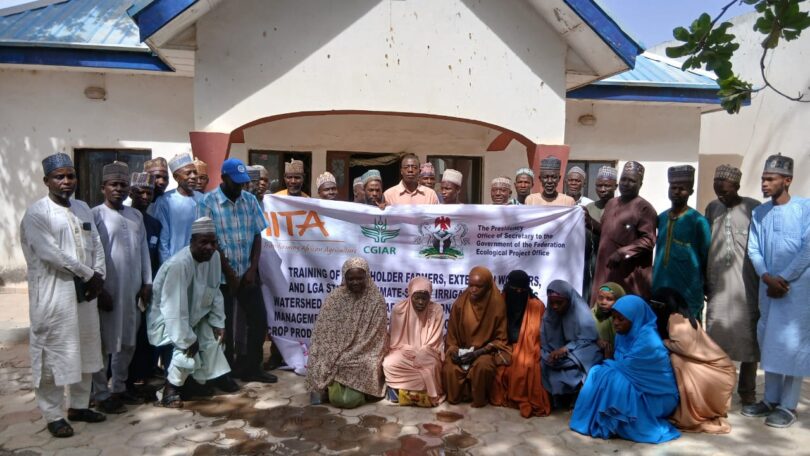
The International Institute of Tropical Agriculture (IITA) has concluded its four-day training programme on climate-smart irrigation and modern agricultural practices, with the closing session held in Karaye Local Government Area of Kano State.
The training, which commenced earlier in the week across four centres—Sumaila, Garko, Tudun Wada, and Karaye—brought together 208 participants, including smallholder farmers, extension agents, and local government agricultural officials from 16 local government areas in the Kano South Senatorial District.
Speaking at the closing session in Karaye, the IITA Research Supervisor, Hassan Joel, who represented the project coordinator, Professor Lucky Omoigui urged farmers to embrace the knowledge acquired during the programme to tackle the challenges posed by climate change.
According to him, the initiative, implemented in collaboration with the Ecological Project Office under the Office of the Secretary to the Government of the Federation, was designed to sensitise farmers to the impact of climate change on agriculture and equip them with practical solutions.
“We have moved across the four locations since the beginning of the training to ensure that participants are properly sensitised and equipped with knowledge on how to address the effects of climate change, including drought, soil infertility, and environmental hazards,” he said.
Read Also:22,000 farmers to benefit from interest-free loans – FG
Hassan explained that farmers were introduced to improved crop varieties such as soybean, cowpea, maize, groundnut, sorghum, and rice, many of which are resistant or tolerant to harsh climatic conditions affecting agricultural production.
He disclosed that the next phase of the programme would involve the establishment of Farmer Field Schools at the onset of the farming season, where practical demonstrations would be conducted.
“At the end of the season, farmers will be able to compare yields from improved varieties with their local crops and see the difference for themselves,” he added.
Also speaking, a facilitator, Amin Idris Yusuf, an engineer with the Kano State Agricultural and Rural Development Authority (KNARDA), said farmers are expected to begin applying climate-smart irrigation techniques introduced during the training.
He urged participants to adopt modern irrigation systems such as drip and sprinkler methods, noting that these approaches ensure efficient water use and improved crop yield.
Read Also:FG expands irrigation to boost dry-season farming, food security in Kano
“In cases where drip irrigation may not be suitable, farmers can adopt sprinkler systems. We also encourage the use of solar-powered irrigation instead of relying on fuel-powered pumps, which are costly and less sustainable,” he said.
SolaceBase reports that Yusuf emphasised the importance of afforestation, calling on farmers to plant trees as a way of mitigating environmental challenges and improving soil conditions.
He warned that rising global food insecurity makes it imperative for farmers to increase productivity through improved agricultural practices.
“With the growing threat of food insecurity, farmers must embrace new methods that will help them produce more food efficiently and sustainably,” he added.
Hassan noted that the programme is anchored on climate-smart agricultural practices aimed at improving food security, increasing farmers’ income, and promoting environmental sustainability.
Read Also:London Halal Forum: ”We’re supporting over 1.2m rural farmers in Northern Nigeria” – WOFAN
“All the practices we have introduced are environmentally friendly and safe for soil, water bodies, and the ecosystem,” he said.
He further confirmed that the training maintained uniformity across all four centres to ensure that participants received equal knowledge and capacity building.
Safiya Kamal is one of the participants who expressed appreciation for the initiative, describing it as timely and impactful in addressing the growing challenges of climate change on agriculture in the region.