LONDON/WASHINGTON – Russia has intensified covert efforts to undermine the leader of Armenia’s bid for re-election in June, fearing his victory could lock in the former Soviet republic’s realignment with the West, according to Western intelligence and government officials.
Moscow’s plans ahead of the June 7 election have included disinformation campaigns in favour of pro-Russian candidates and an audacious scheme to transport tens of thousands of Russian-Armenians to sway the vote, according to interviews with five Western intelligence officials and documents seen by Reuters.
A landlocked nation of three million people, Armenia has mostly remained in Moscow’s orbit since the Cold War and hosts Russian troops.
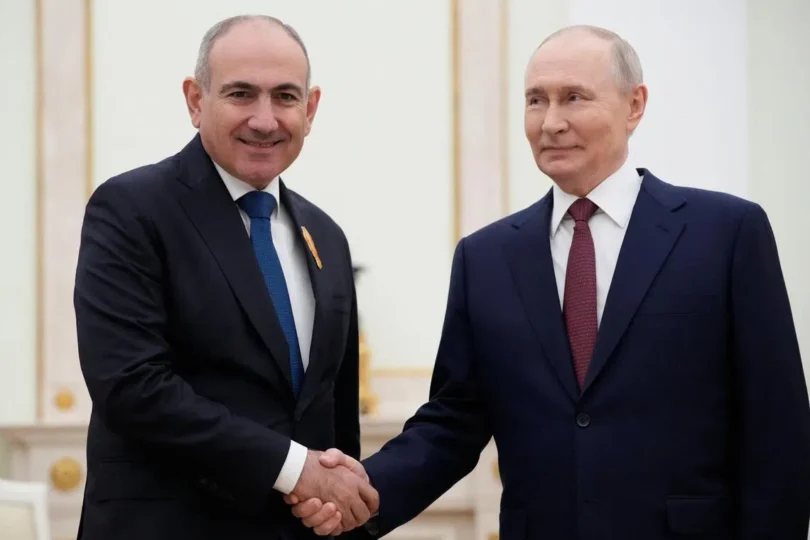
But Prime Minister Nikol Pashinyan, who is leading in the polls, has moved closer to Europe and NATO, emerging as an ally of US President Donald Trump, who on May 27 endorsed Mr Pashinyan’s re-election bid.
US Secretary of State Marco Rubio flew to Yerevan this week, signing a minerals deal and an agreement for the Trump Route for International Peace and Prosperity – a proposed transport corridor through Armenia that could further erode Russian influence in the region.
Armenia, a member of a Russian-led economic union, suspended its participation in Moscow’s regional security alliance in 2024. This month it hosted NATO’s chief at a European leaders summit.
Russian President Vladimir Putin has made no secret of his displeasure at Mr Pashinyan’s pivot. In recent days, Moscow has warned that Armenia risked forfeiting cheap natural gas supplies and it restricted imports of Armenian products including fruit, vegetables, flowers and brandy.
“What Pashinyan is trying to do is a threat to Russia,” said Mr Thomas de Waal, senior fellow with Carnegie Europe. Diversification “means Russia loses the virtual monopoly it’s had in Armenia.”
Moscow’s preferred candidate, three of the Western officials said, is Mr Samvel Karapetyan, a billionaire on trial for allegedly calling for the overthrow of the government.
Mr Karapetyan, who is Armenian-Russian, denies the charges. His lawyer, Mr Robert Amsterdam, told Reuters his client had no knowledge of Russian support.
Europe has long accused Russia of election meddling, most recently in Moldova and Hungary. Russia alleges that the EU and the United States interfere in countries near its borders to pull them into the West’s sphere of influence.
Russia’s foreign ministry did not respond to a comment request, but on May 28 told reporters that claims Russia was interfering in Armenia’s internal affairs were “spymania”.
Armenia’s government communications department declined to comment on the specific allegations made in this story, but outlined measures being taken to tackle disinformation and ensure the elections would be free, fair, and transparent.
In October, the Kremlin established a department known as the Directorate for Strategic Cooperation and Partnership, which, four of the sources said, is overseeing influence operations in Armenia. The sources, like others in this story, spoke on condition of anonymity.
Russian officials have in recent months discussed sending Russia-based Armenians to vote for Mr Pashinyan’s opponents, five of the sources said.
Armenians make up a large global diaspora, including a population in Russia that some estimates put at over two million. Armenians are not allowed to vote in elections from abroad.
One source, a senior US official, said the volumes of people that Moscow could succeed in transporting was a matter of debate within the intelligence community. However, the source said, intelligence officials take the idea seriously. Armenians routinely travel between the nations, and dozens of flights depart daily.
Russian authorities calculated a cost of about US$50 million (S$63 million) to transport 100,000 voters, three of the sources said. By mid-May, the Kremlin had issued quotas of Armenians each region should send and requested administrators report back on preparations, those officials added.
Reuters was unable to establish whether such a plan was under way or whether it would be enough to close the wide gap between the frontrunners.
A poll conducted earlier this month suggested Mr Pashinyan’s Civil Contract party will finish first with around 30 per cent of the vote.
At around 6 per cent, the poll put Mr Karapetyan’s Strong Armenia party at a distant second in a crowded field.
Mr Pashinyan took office in 2018 when protests toppled his Moscow-aligned predecessor. Ties deteriorated after Russian peacekeepers stationed in Nagorno-Karabakh, an ethnically Armenian breakaway region within the country’s neighbour Azerbaijan, failed to prevent it from falling to Azerbaijan in 2023.
In August, Mr Pashinyan reached a US-brokered peace agreement to end the decades-old conflict between Armenia and Azerbaijan over the disputed region. The deal would open the transport route across southern Armenia, allowing goods to flow east towards Central Asia, in return for giving Azerbaijan direct access to its exclave of Nakhchivan and to Turkey. Moscow cautiously welcomed the deal.
Washington has said US-backed security personnel could oversee the narrow strip of land, which would run along the border with Iran, a possibility the intelligence officials said Russia sees as unacceptable.
Should Mr Pashinyan lose power, key elements of Mr Trump’s peace effort would likely fizzle, according to two Western officials.
In a video that circulated online in May, masked men speaking an Armenian dialect threatened to kill Mr Pashinyan. Reuters could not establish if the threat was real or who was behind it. The case is under investigation in Armenia.
Three of the sources, including a senior US official, described serious and ongoing concerns regarding the Armenian leader’s safety, without elaborating.
Elements of the US government, including the Central Intelligence Agency, have in recent years covertly aided Mr Pashinyan’s personal protection, according to a current US official, a former US official and a third person with knowledge of the arrangement. One source said the aid included sharing information about potential threats.
The White House, State Department, US Office of the Director of National Intelligence and Mr Pashinyan’s office did not respond to requests for comment about the prime minister’s security situation. The CIA declined to comment.
Russian officials have stepped up existing online disinformation campaigns to discredit the Mr Pashinyan government, the officials added.
In one example, a Russian-backed online campaign falsely alleged a corrupt land deal involving Mr Pashinyan with Ms Jeanne Shaheen and Mr Thom Tillis, two US senators who publicly expressed concern in April about Russian disinformation, the US official said.
Ms Shaheen and Mr Tillis did not respond to a request for comment.
One European official said the campaigns involve a Kremlin-affiliated bot network known as “Storm-1516”, which played a role in efforts to interfere with recent US elections.
Three of the sources said the Kremlin had enlisted Russian political consultancies and think-tanks, including the Social Design Agency (SDA), sanctioned in the European Union and the United Kingdom for spreading disinformation to undermine support for Ukraine.
Reuters reviewed five Russian-language documents that the sources said were drawn up by SDA. The news organisation could not independently verify that SDA drew up the documents.
One of the documents proposed creating a media outlet called Yerevan1 for Russia’s Armenian diaspora to promote a “negative attitude” of Mr Pashinyan with a “core narrative” that “Armenia can only prosper in a close alliance with Russia and under its protection.”
Neither SDA nor Yerevan1 responded to comment requests.
The document assessed that Russian-Armenians could play a decisive role in the election if “high turnout among them can be ensured”. REUTERS