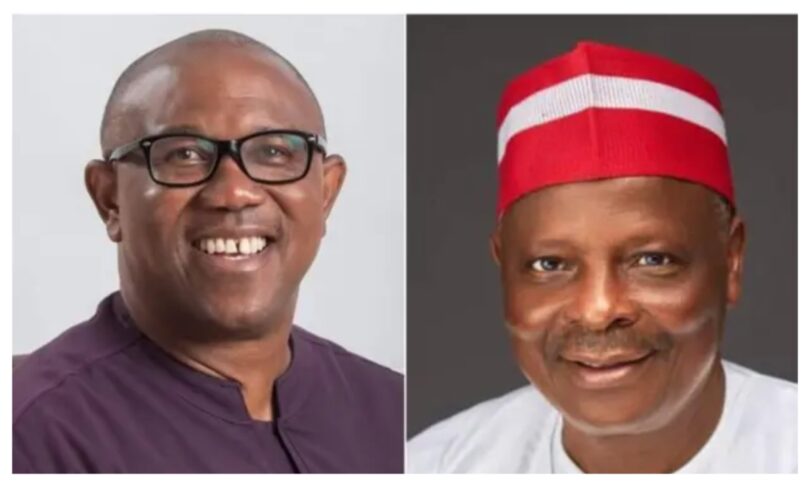
The Kwankwasiyya Movement has responded to growing reactions surrounding the reported political understanding between its national leader, Rabiu Musa Kwankwaso, and Peter Obi under the platform of the Nigeria Democratic Congress (NDC), describing recent criticisms as unfair and misleading.In a statement on Friday signed by Dr. Habibu Sale Mohammed, spokesperson of the Kwankwasiyya Movement,
the group said while many Nigerians have welcomed the development as a step toward national unity and stronger democracy, some commentators, particularly from parts of the Northern political space have chosen to attack Kwankwaso.
“It is unfortunate that some commentators… have resorted to selective attacks and misleading narratives aimed specifically at discrediting Senator Rabiu Musa Kwankwaso,” the statement read.
The movement said what is troubling certain interests is not just the possibility of cooperation between both leaders, but the political strength such an alliance could bring.
“What appears to be troubling certain interests is not merely the possibility of political cooperation, but the enormous national potential such an alliance represents,” it stated.
According to the group, the coming together of Kwankwaso and Obi could mark a major shift in Nigeria’s opposition politics by bridging long-standing regional divides.
It noted that Kwankwaso has a strong grassroots structure in Northern Nigeria, especially in Kano and the Northwest, while Obi enjoys wide support among youths, urban voters, and many in Southern Nigeria.
“Naturally, the prospect of both leaders working together introduces a completely new political equation one that transcends ethnicity, religion, and regional sentiment,” the statement added.
The group suggested that this is why some political actors are reacting negatively.“This explains the panic in certain quarters,” it said.
It also accused critics of applying double standards by labeling Kwankwaso negatively while praising similar political moves by others.
“Some commentators have chosen to launch targeted attacks… portraying him as ambitious or disruptive, while describing similar engagements by others as strategic and patriotic. This double standard is both unfortunate and revealing,” the statement said.
The Kwankwasiyya Movement maintained that any objective observer would understand the impact such an alliance could have.
“The coming together of two leaders with proven electoral strength… has the capacity to fundamentally reshape Nigeria’s democratic landscape,” it noted.
He added that those dismissing it are expressing political fear.
The statement also defended Kwankwaso’s political record, describing his influence as rooted in grassroots support rather than media or federal power.
“His political relevance is not manufactured… It is rooted in years of service, grassroots connection, and the trust of millions of Nigerians,” it said.
The group rejected what it described as attempts to reduce a major political development into petty elite propaganda and personality attacks.
It stressed that Nigeria is currently facing serious economic, security, and governance challenges, and citizens are demanding issue-based politics and credible leadership.
“Any political understanding that seeks to unite Nigerians… should be encouraged rather than demonized,” it added.
The movement called on political actors and commentators to show fairness and focus on national interest.
“Democracy thrives through coalition-building, inclusion, and healthy political competition—not through selective hostility,” the statement said.
It concluded by reaffirming its commitment to Nigeria’s democratic future.
“We believe the Nigerian people deserve a political environment built on unity, mutual respect, and constructive national engagement.”